

Before starting as a self-employed person in your own name, you register with the Crossroads Bank for Enterprises (BCE/KBO) through a business counter. You also join a social insurance fund before the activity begins.
The essentials
Register with the BCE/KBO before your first sale, whatever your turnover.
In 2026, the VAT exemption applies up to 25,000 euros of turnover, reduced pro rata if you start during the year.
Since 1 January 2026, your invoices to clients registered for VAT in Belgium go, in principle, through the Peppol network, even under the exemption.
The reduction, the waiver and the bridging right must be requested: none of these safety nets applies automatically.
What are the steps to become self-employed in 2026?
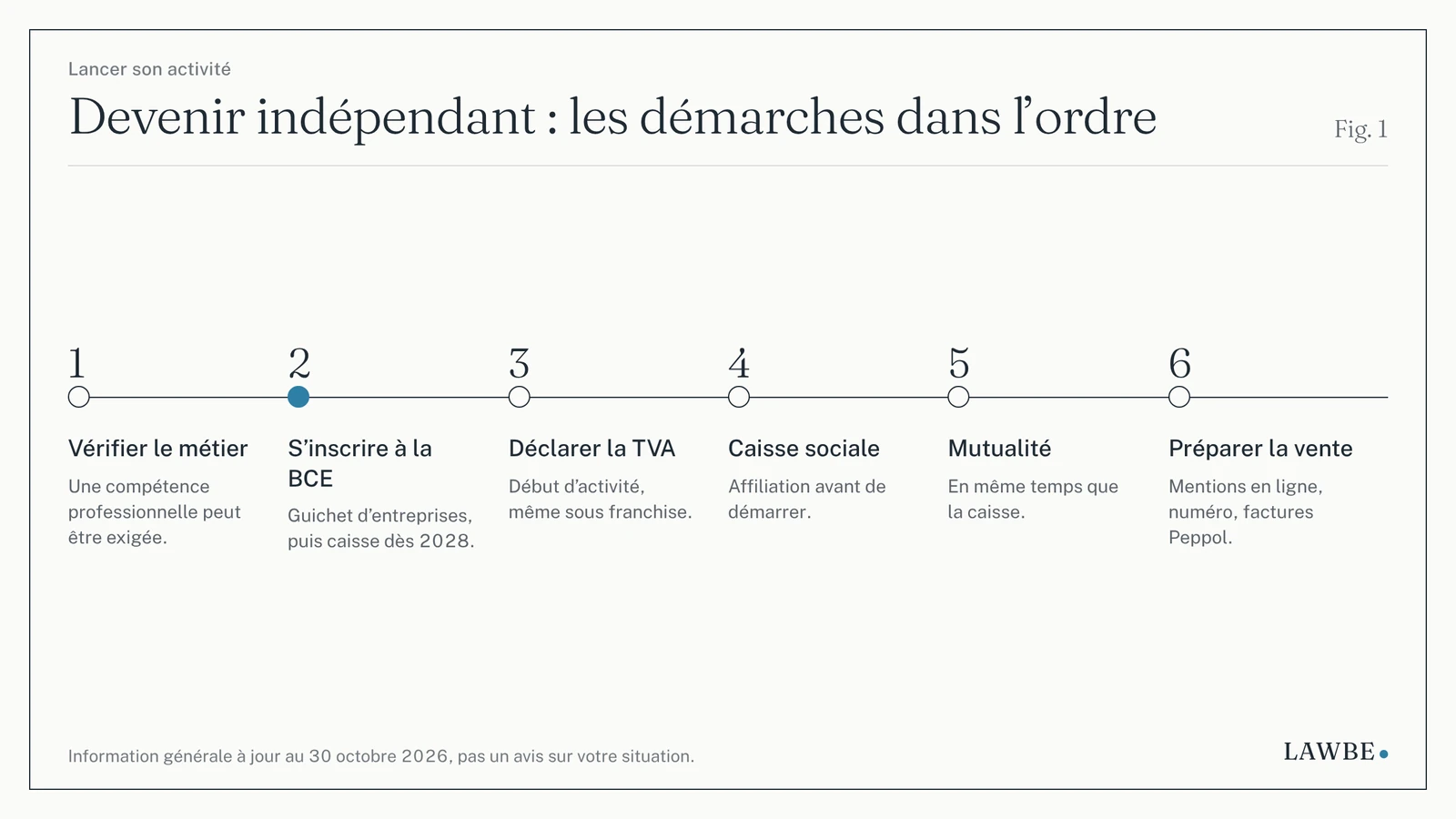
Count six steps, and most are settled before your first client.
The first concerns your trade. Flanders no longer requires basic management knowledge since 2018, Brussels since 2024 and Wallonia since 2025. Some trades keep, in Brussels and Wallonia, a sectoral professional qualification, without which the counter refuses the registration.
You choose your approved business counter, online or in an office, and it can activate your VAT number. It registers you immediately, against a fee set by royal decree and indexable on 1 January. Until 31 December 2027, registration goes through a business counter; from 1 January 2028, it will be done through a social insurance fund.
According to the National Institute for the Social Security of the Self-employed (INASTI/RSVZ), joining a health insurance fund (mutualité) is done at the same time as joining the social insurance fund.
| Step | Where | When | Cost |
|---|---|---|---|
| 1. Check access to the trade | Business counter | Before registration | Variable |
| 2. Register with the BCE/KBO | Approved business counter, online or in an office (social insurance fund from 2028) | Before starting | Variable (fee set by royal decree) |
| 3. Declare the start of activity for VAT, exemption included | VAT administration, or through the counter | At the start of the activity | Variable |
| 4. Join a social insurance fund | The fund of your choice | Before the activity begins | Variable (depending on income, plus management fees) |
| 5. Join a health insurance fund | A health insurance fund | At the same time as the social insurance fund | Variable |
| 6. Prepare to sell: online particulars, number on invoices, Peppol | Your website; your invoicing software | Before the first sale or invoice | Variable |
This article concerns the natural person, all of whose assets are in principle liable for professional debts. In an SRL, the shareholders only commit their contribution. The choice is prepared with Setting up an SRL in Belgium: 2026 guide and the Launching your project journey.
Do I need a VAT number if I stay under the exemption?
Yes: according to the FPS Finance, in 2026 you request the exemption in your declaration of start of activity (e604A), and you keep a VAT number.
In 2026, the exemption applies if your annual turnover achieved in Belgium does not exceed 25,000 euros. Since 20 February 2026, this threshold is reduced pro rata to the days elapsed since 1 January if you start during the year.
Your invoices carry the statement "Special exemption scheme for small enterprises" (Régime particulier de la franchise de taxe) in place of VAT. You do not file periodic returns, but you report the previous year's turnover by 31 March at the latest.
The threshold will rise to 26,000 euros in 2027, then increase by 1,000 euros a year up to 30,000 euros in 2031. Have your accountant calculate your actual threshold.
Must I send electronic invoices to my business clients?
Yes, as soon as you invoice a business registered for VAT in Belgium: since 1 January 2026, your invoice must be structured and go through the Peppol network. According to the federal e-invoicing website, this obligation in principle also covers the VAT-exempt taxable person. Your sales to consumers remain outside its scope.
If a business client is technically unable to receive a structured invoice, you send them an ordinary invoice.
Not having the technical means to issue and receive these invoices costs, since 1 January 2026, 1,500 euros, then 3,000 euros the second time and 5,000 euros thereafter.
What must be displayed to sell online?
Your website gives easy and permanent access to your name, your geographical address, your email and your enterprise number. Add your VAT number if you are registered, and your general terms and conditions if you use them. See the guide to general terms and conditions of sale.
Towards a consumer, you give before the order the total price including all taxes, the delivery costs and the withdrawal rules. In the event of a dispute, it is for you to prove that you gave this information.
What changes for a secondary activity or for a student?
The formalities remain those of any self-employed person; it is the contributions that change. As a secondary activity, your activity is added to another professional activity carried on as your main occupation, salaried employment for example. No contribution is due as long as your self-employed income stays below an annual threshold, which your fund tells you.
Re-read your employment contract before starting: while it is being performed, you refrain from any unfair competition towards your employer. The Brussels Labour Court of Appeal upheld serious cause for a conflict of interest. It recalled that before the law of 7 October 2022, an exclusivity clause covering any activity was void.
If you are studying, student-entrepreneur status is obtained on request, if you are enrolled as your main occupation in studies that lead to a recognised diploma.
Its contributions follow a specific rule, with a first band of income without contribution.
What do you risk by invoicing without an enterprise number?
Trading without having applied for registration with the BCE/KBO exposes you to a level 2 sanction under the Code of Economic Law (CDE). At that level, the maximum criminal fine can reach 4% of annual turnover, if it exceeds the ceiling in euros. The absence of the number on your invoices falls under level 1.
The most concrete risk plays out before the court. If you were not yet registered on the day you bring your action, the court declares it inadmissible of its own motion. The court then does not examine your unpaid invoice; see Recovering a debt between businesses.
Without membership of a social insurance fund, the administrative fine ranges from 500 to 2,000 euros for each breach found, under the article in its version in force since 1 October 2025.
According to the FPS Economy, occasionally reselling your own belongings does not make you a business, unlike placing goods or services on the market on a lasting basis.
The law sets no threshold in euros for becoming a business. Platforms report to the tax authorities a seller of goods from 30 sales or more than 2,000 euros of sales, per year and per platform. According to the FPS Finance, this threshold does not say whether you must declare your income.
What safety nets if your activity earns little?
The social status of the self-employed does not cover unemployment: it covers family benefits, pension, sickness, invalidity, maternity and the bridging right. For sickness, the allowance first requires a six-month qualifying period.
At the start of the activity, your fund may, on request and on the basis of objective elements, reduce your provisional contributions, without refunding what has already been paid.
In temporary financial difficulty, you can then request a waiver from INASTI/RSVZ, which may refuse if you have not first requested the reduction. Waived contributions count towards your social rights, except the retirement and survivor's pension.
The bridging right pays a monthly benefit and maintains your rights to healthcare and allowances. It applies if you have to interrupt or stop your activity against your will, or if you officially stop for economic difficulties.
You must have been subject to the scheme during the four quarters preceding the quarter following that of the event. You must also have paid contributions, or pension rights, for four quarters out of sixteen. The text refers to certain categories of contributions: your fund tells you whether yours are among them. Apply to your fund for the bridging right by the second quarter following that of the event at the latest.
What I actually do
I calculate neither your contributions nor your VAT: those figures are for your accountant. During a 45-minute scoping call, prepaid, 120 euros, I check the order of your steps, the particulars on your website and, for a secondary activity, your exclusivity clause. The Business law page presents chasing an unpaid invoice, from 290 euros, and setting up a company, on quote.
For your first clients, I review a contract from 490 euros or I draft your general terms and conditions, from 390 to 2,300 euros (Contracts). The exact price is given in writing after the first contact, which is free. Amounts excl. VAT.
Frequently asked questions
Must I register with the BCE/KBO for a secondary activity?
Yes, registration is required of every business before starting, whether the activity is primary or secondary.
Under 25,000 euros of turnover, do I need an enterprise number?
Yes: 25,000 euros is the 2026 threshold for the VAT exemption, whereas registration with the BCE/KBO precedes the start, with no threshold.
What should I do if I stop my activity?
Request the removal of your registration from the BCE/KBO within one month of stopping.
How much do social contributions cost?
They depend on your income and your scheme, plus the fund's management fees. Your fund and your accountant give you the amounts for the year.
Are you preparing your launch as a self-employed person? Write to me about your situation in three lines.
Sources
- Code of Economic Law, art. I.1, III.25, III.26, III.49, III.50, III.52, III.54, III.55, III.74, VI.45, XII.6, XV.70, XV.76 and XV.77 (consolidated text, Justel, NUMAC 2013A11134).
- Royal decree no. 38 of 27 July 1967 organising the social status of self-employed workers, art. 1, 5quater, 10, 11, 12, 12bis, 17, 17bis and 20 (Justel, NUMAC 1967072702).
- VAT Code, art. 53 and 56ter: laws of 6 February 2024 (NUMAC 2024001635), 21 March 2024 (NUMAC 2024002757), 10 February 2026 (NUMAC 2026001291) and 23 September 2026 (NUMAC 2026007237); royal decrees of 15 December 2024 (NUMAC 2024011655) and 8 July 2025 (NUMAC 2025005169).
- Law of 8 October 2026, art. 19 and 45 (NUMAC 2026007652).
- Law of 21 December 2022 transposing the DAC7 Directive, art. 4 (NUMAC 2022043134); programme law of 26 December 2022, art. 189 to 194 (NUMAC 2022043127).
- Royal decree of 20 July 1971, art. 14 (NUMAC 1971072008); law of 3 July 1978 on employment contracts, art. 17 (NUMAC 1978070303).
- Civil Code, Book 3, art. 3.35; Code of Companies and Associations, art. 5:1.
- Regional acts abolishing proof of basic management knowledge (NUMAC 2018012401, 2023048156 and 2025007333).
- Brussels Labour Court of Appeal, 26 November 2025, R.G. 2024/AB/359 (ECLI:BE:CTBRL:2025:ARR.20251126.1).
- Official pages of the FPS Finance, the FPS Economy, INASTI/RSVZ and the e-invoicing portal (consulted on 28 and 29 October 2026).
This article is general information, current as of 30 October 2026. It is not an opinion on your situation.
Translated from the French original published on 30 October 2026. The analysis concerns Belgian and European Union law. Read the French original.