

You type your company's name into Google and the first ad is a competitor's. That is often permitted. What is not permitted is an ad that leads people to believe it comes from you.
The essentials
Buying a competitor's trademark as a keyword is permitted; the ad becomes actionable when the internet user cannot easily tell that it comes from someone other than you.
Capture the ad and the advertiser before any complaint: once an ad is removed, that information disappears from the public register.
A registered trademark gives you the most options: complaint to Google, formal notice, action before the court.
Can a competitor buy my trademark as a keyword?
Yes, in principle. The advertiser who selects your trademark as a keyword makes use of it. You can only prohibit it in one case: their ad does not enable, or only with difficulty enables, the user to tell where the goods come from. The court asks whether a reasonably well-informed and reasonably observant internet user understands that the offer comes from you, from a company linked to you, or from a third party.
Google itself does not use your trademark: it only creates the technical conditions for its client's use. The Court of Justice ruled so in 2010 in the Google France case, and the rule is now found in the Trade Marks Directive.
For a Benelux trademark, the Benelux Convention sets out the same cases.
Is your trademark well known? An ad that simply proposes an alternative, without imitation, dilution or tarnishment, falls in principle within fair and healthy competition.
When does the ad become unlawful?
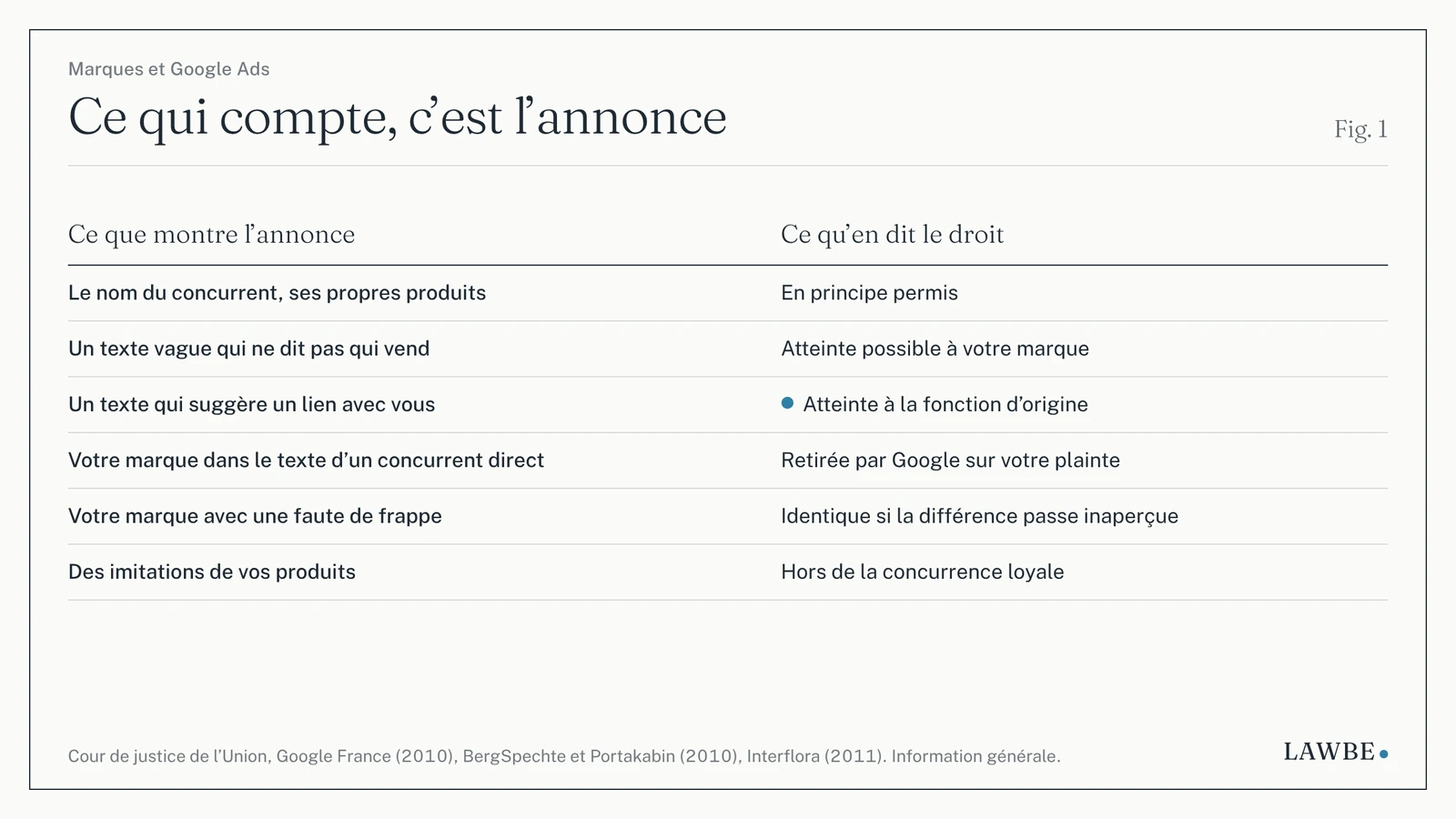
Everything turns on what the ad shows the internet user. It infringes your trademark if it suggests an economic link with you, or if it remains so vague that the user cannot tell who is selling.
| What the ad shows | What the law says |
|---|---|
| The competitor's name, its own products | Permitted in principle |
| Vague wording that does not say who is selling | Possible infringement of your trademark |
| Wording that suggests a link with you | Infringement of the trademark's function of origin |
| Your trademark in the text of a direct competitor | Removed by Google on your complaint |
| Your trademark with a typo | Identical if the difference goes unnoticed |
| Imitations of your products | Outside fair competition |
A keyword that reproduces your trademark with a small error can be treated as identical, if the difference goes unnoticed.
A reseller of your genuine products may, in principle, use your trademark, unless you have a legitimate reason to object.
Belgian courts do not all apply this line with the same flexibility. A reference work criticises a 2015 judgment of the Mons Court of Appeal that condemned the purchase of a veranda seller's trademark as a keyword. The authors consider it too strict.
How do I get the ad removed?
In this order, because each step prepares the next.
Capture first. Google's Ads Transparency Center lets you search for an advertiser by name or website, and filter by date and by region. It displays the legal name of verified advertisers. Do this before any complaint: when a very large search engine removes an ad for illegality, its public register keeps neither the content, nor the advertiser, nor the payer. Also capture the results page, with the date, the time and the address.
Then report the ad to Google. Its policy does not restrict the use of a trademark as a keyword. On complaint, it restricts the use of the trademark in the ad text of a direct competitor, or in a misleading way. Resellers, information sites and descriptive use are exceptions.
Google only handles complaints against specific advertisers, identified by their address, in the countries and sectors where you demonstrate your rights. Against a keyword that does not appear in the ad, this route therefore yields nothing.
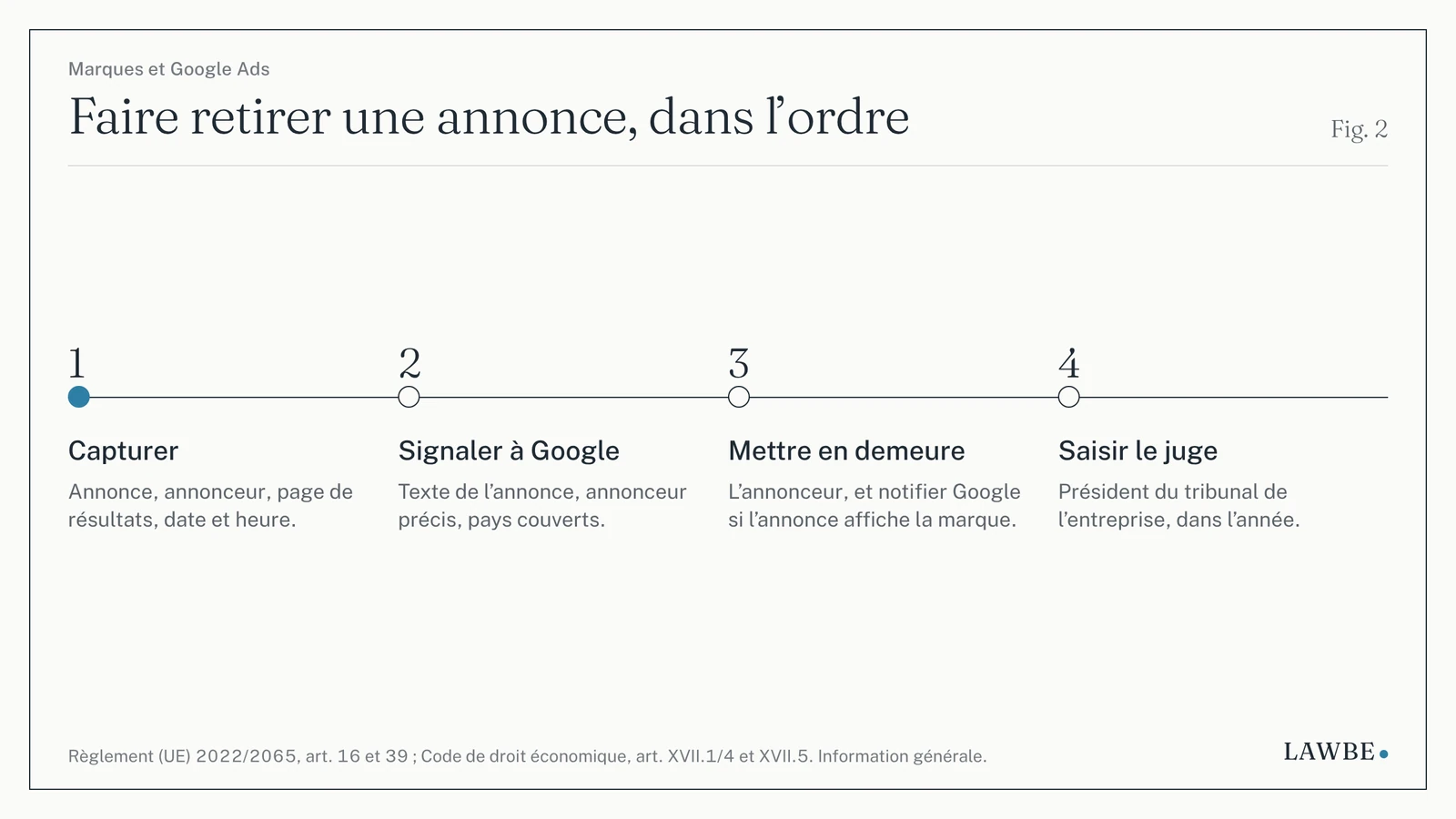
Send a formal notice to the advertiser. The legal name displayed by Google makes it possible, in my view, to find the company in the Crossroads Bank for Enterprises (BCE/KBO). You can also send Google a legal notice: a precise notice, which enables a diligent provider to identify the illegality without a detailed legal examination, amounts to actual knowledge. In my view, it works against an ad that displays your trademark, much less against the mere purchase of the keyword.
Finally, go to court. The president of the Commercial Court (tribunal de l'entreprise) may order the act to cease. The action based on the Code of Economic Law (CDE) is no longer admissible one year after the facts end.
What if I only have a trade name, without a trademark?
The Benelux Convention protects the registered trademark, not the unregistered sign. Your trade name is then defended through market practices law. It prohibits, between businesses, acts contrary to honest market practices, and any marketing activity that creates confusion with a competitor's trade name.
In my view, the purchase of your name alone as a keyword will be difficult to have condemned if the ad is clear. There needs to be confusion maintained by the ad, or another circumstance. Google's complaint procedure, moreover, concerns trademark rights. If your name matters to your business, read Protecting your trade name in Belgium without a trademark, then consider filing it.
My competitor put my name in the code of its website: is that permitted?
Meta tags that reproduce a competitor's trade name or product names are advertising: they suggest to the internet user that the site is related to their search. The fact that they remain invisible changes nothing.
Google states that the meta keywords tag is not used by its search and has no effect on indexing or ranking. Your name in that tag therefore does not help your competitor; in my view, it remains evidence of intent. Legal writing notes that Belgian courts have often condemned the use of a competitor's name or trademark in meta tags to capture its customers.
Everything rests on proof of the source code at a certain date. A bailiff's report is authentic for the material facts the bailiff perceives directly.
Can I mention a competitor's trademark in my own advertising?
Yes, in comparative advertising that meets eight conditions. It must not mislead, must compare goods meeting the same needs, and must objectively compare material, relevant, verifiable and representative features. It must not create confusion, must not discredit, must not take unfair advantage of the reputation of the competitor's trademark and must not present your product as an imitation.
A comparison that does not meet these conditions is prohibited, and the trademark holder may then object to the use of its sign. In my view, an ad reading "the alternative to" followed by a competitor's trademark is comparative advertising and must therefore meet these eight conditions.
What I actually do
I first look at the ad, your titles and your captures, and I tell you which route has a chance of succeeding. I then draft the complaint to Google, the formal notice to the advertiser and, if necessary, the court action. If your name is not yet a trademark, I check whether it can become one.
On the Trademarks page, defending a trademark costs from 690 to 2,600 euros, plus fees. Checking a name costs from 390 to 590 euros, and filing it in the Benelux or the Union from 890 to 1,590 euros, plus official fees. The exact price is given in writing after the first contact, which is free. Amounts excl. VAT.
Frequently asked questions
Can I buy my competitor's trademark as a keyword?
Yes, if your ad clearly says who you are and suggests no link with them. Do not write their trademark in the ad text without following the rules on comparative advertising: Google removes such text on complaint from a direct competitor.
Can Google be held liable?
Not as an infringer: it does not use the trademark. It must, however, handle a precise notice in a timely, diligent and objective manner.
How long do I have to act?
The cease-and-desist action based on the Code of Economic Law is no longer admissible one year after the facts end. As long as the ad is running, the facts have not ended; it is still better to act quickly, while it is still visible.
Is a screenshot enough?
It helps, but your opponent can contest it. A bailiff's report is authentic for what the bailiff observes directly.
A competitor is appearing on your name. Write to me about your situation in three lines.
Sources
- CJEU, Google France and Google, C-236/08 to C-238/08, 23 March 2010, paragraphs 51, 57 and 84 (CELEX 62008CJ0236); BergSpechte, C-278/08, 25 March 2010, paragraph 36; Portakabin, C-558/08, 8 July 2010, paragraphs 48 and 76 to 93; Interflora, C-323/09, 22 September 2011, paragraph 91; BEST, C-657/11, 11 July 2013, paragraphs 57 and 58.
- Directive (EU) 2015/2436 on trade marks, art. 10 (CELEX 32015L2436); Directive 2006/114/EC concerning misleading and comparative advertising, art. 4 (CELEX 32006L0114); Regulation (EU) 2022/2065 on digital services, art. 16 and 39 (CELEX 32022R2065).
- Benelux Convention on Intellectual Property, art. 2.20 (Protocol of 11 December 2017, NUMAC 2018015720).
- Code of Economic Law, art. VI.17, VI.104, VI.105, XVII.1/4 and XVII.5 (consolidated text, Justel, NUMAC 2013A11134). Judicial Code, art. 519 (NUMAC 1967101053).
- Google, Google Ads "Trademarks" policy and "Ads Transparency Center"; Google Search Central, "Meta tags and attributes that Google supports" (consulted on 30 October 2026).
- "Droit du marketing", Larcier, 2023, pp. 234 and 235; "Les pratiques loyales", Larcier, no. 305.
This article is general information, current as of 30 October 2026. It is not an opinion on your situation.
Translated from the French original published on 30 October 2026. The analysis concerns Belgian and European Union law. Read the French original.