

In Belgium, your trade name is protected without any filing, from its first public use. That protection only applies in the area where your name is known, and it requires a likelihood of confusion. To cover the whole Benelux and the web, a trademark remains, in my view, the safest tool.
The essentials
The right arises from the first public and continuous use of the name; registration with the Crossroads Bank for Enterprises (BCE/KBO) is not required.
There is no fixed radius: protection covers the area where your name is actually known.
Your trade name alone is not enough to oppose a Benelux trademark filed after you.
React without delay: a late reaction can be held against you, and the cease-and-desist action closes one year after the facts end.
Is my trade name protected without a trademark?
Yes, and without any formality: the Paris Convention protects the trade name "without the obligation of filing or registration". In Belgium, this right is enforced through the rule that prohibits, between businesses, acts contrary to honest market practices.
Since 2019, creating confusion with a competitor's trade name is also a misleading practice between businesses.
The right belongs to the first person who uses the name in good faith, publicly, visibly and continuously, for their business. A name left without public use for a long time is lost.
Registration with the BCE/KBO is not a condition of protection. Only actual use with your customers counts.
When does a competitor's name create confusion?
According to the Court of Cassation (Cour de cassation), the court may make protection subject to a danger of confusion, which it assesses at its discretion. It weighs three factors, which need not all be present: the similarity of the names, the proximity of the activities and the geographical area. Regardless of this factor, your protection only applies in the area where your name is known.
Two bakeries with the same name in the same street meet all three. A mere likelihood of association is not enough, and it is for you to prove that confusion may arise in your area.
Is my name protected within a radius of 10 km?
No rule sets a radius, whether 10 km or any other distance.
Protection applies where your name is known and used publicly: a village, a town, a region or the country, depending on its reputation.
Only the area of activity counts, not the address of the registered office; a hospitality business or a grocery shop has, in principle, only a limited sphere of influence.
The distances found in case law apply to each case, never as thresholds. The Liège Court of Appeal found confusion between two adjoining buildings with different activities, and sanctioned the use of a name between two garages 16.2 km apart.
For two businesses one kilometre apart, the Brussels Court of Appeal ordered the use to stop in the Brussels Region and within 50 km of it. The Ghent Court of Appeal limited it to the cantons of Bruges. The Antwerp Court of Appeal saw no confusion with a hotel opened in the Netherlands, 105 km away, on a different concept.
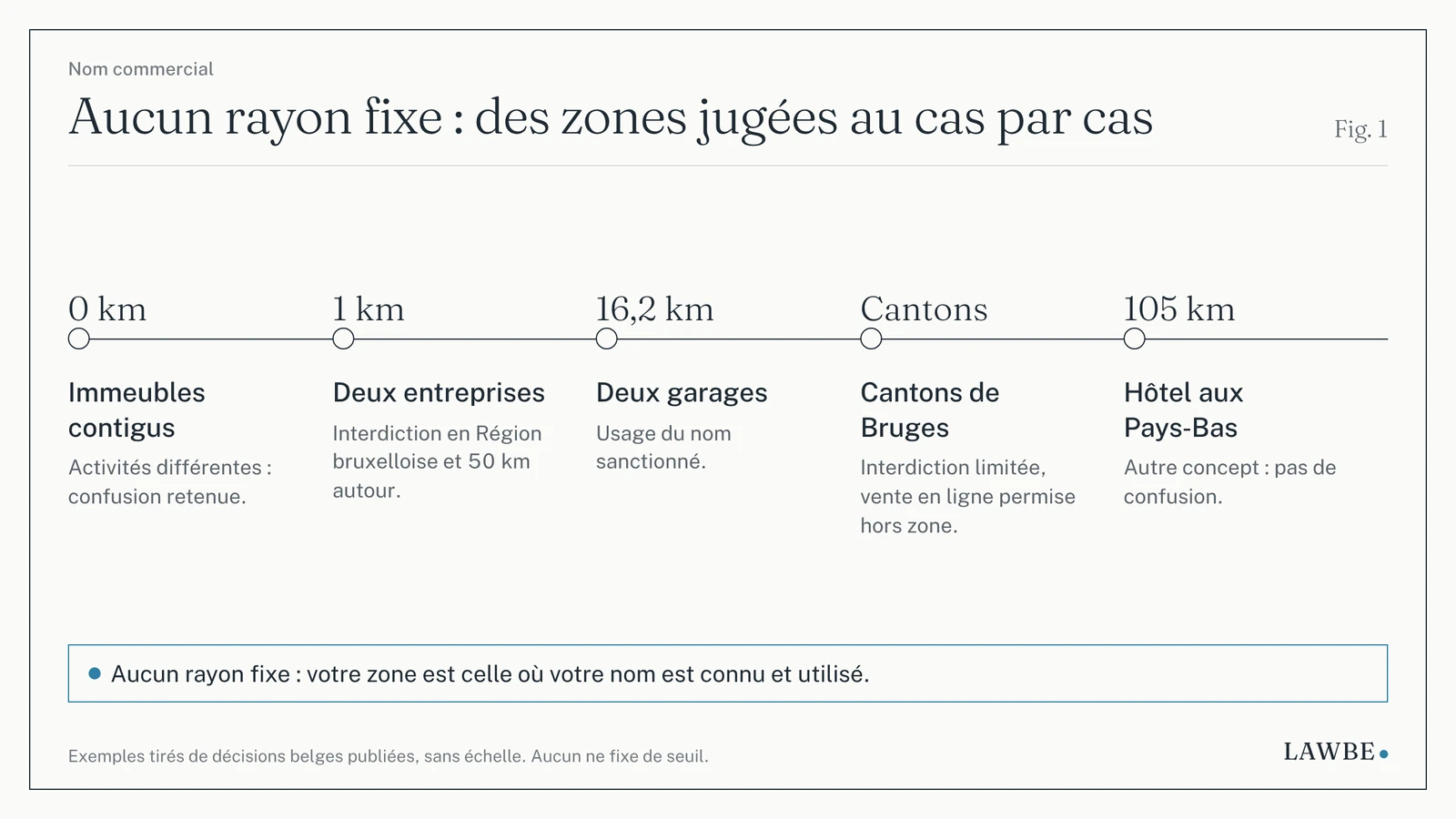
Faced with a later name used throughout the country, you can only act where your name is known; elsewhere, the two names coexist.
Trade name, trademark, company name: what is the difference?
The trade name is the name under which the business trades; the company name is the statutory name of the company.
| Sign | How the right arises | Territory | What it allows you to do |
|---|---|---|---|
| Trade name | First public and continuous use | Area where the name is known | Stop a use that causes confusion in that area |
| Trademark | Registration with the Benelux Office for Intellectual Property (BOIP) or the EU Intellectual Property Office (EUIPO) | Benelux or the whole Union | Prohibit an identical or similar sign, even as a trade name |
| Company name | Articles of association | Regardless of location (legal writing) | Have an identical or misleadingly similar name changed |
| Domain name | Registration with the registry | None; a website does not automatically widen your area | Against a name taken without right, to harm you or profit from your name: cancellation or transfer |
The Benelux trademark covers Belgium, the Netherlands and Luxembourg, and the right arises from registration. Its holder may prohibit the use of a sign as a trade name, under the conditions of the convention.
A name that describes your trade or your product offers weak protection. For an EU trademark, lack of distinctive character and descriptiveness are absolute grounds for refusal.
If your name is also your company name, any interested party may have the identical or misleadingly similar name of another company changed, and claim damages. According to legal writing, the comparison is made regardless of location. In my view, this rule does not protect the shop sign of a sole trader.
Company name and trademark should be checked together, from incorporation: see Setting up an SRL in Belgium: 2026 guide.
A competitor has filed my name as a trademark: what can I do?
You cannot oppose their Benelux trademark on the sole basis of your trade name. What remains is invalidity for bad-faith filing.
Your name keeps its force where it is known. The trademark does not allow its holder to prohibit there the use of an earlier right of local significance, and a trade name can be such a right.
The Brussels Court of Appeal even refused to invalidate a later trademark while prohibiting its use, as a source of confusion with the earlier name.
Against an EU trademark, opposition and invalidity require genuine use of the name of more than mere local significance. Failing that, you can oppose its use in your territory, if Belgian law allows it. You lose this right if you have knowingly tolerated that use for five years, unless the trademark was filed in bad faith.
If you file your name after having used it, the trademark does not, in my view, date back to your first use: the right arises from registration.
If a competitor copies a trademark you have already registered, read instead trademark infringement: what to do.
And online: website, domain name, Instagram?
A website or a Facebook page does not automatically widen your area. In the Bruges case, the Ghent Court of Appeal let the competitor sell online, except to customers in the protected area.
The law prohibits registering, without right or legitimate interest, to cause harm or take undue advantage, a domain name that reproduces your trade name or is confusingly similar to it. The president of the court may order its cancellation or transfer, and DNS Belgium opens an out-of-court procedure to the holder of a trade name.
On Instagram, the "trademark" complaint form requires a registered trademark, with its country and number. In my view, reserve your domain names and usernames as soon as you open. If it is your texts or your visuals that are being copied, the question falls under copyright: see Copied idea or concept.
How to react, and within what time limits?
First check the three conditions: earlier use, confusion, area. If one is missing, look at your other titles: trademark, company name, domain name.
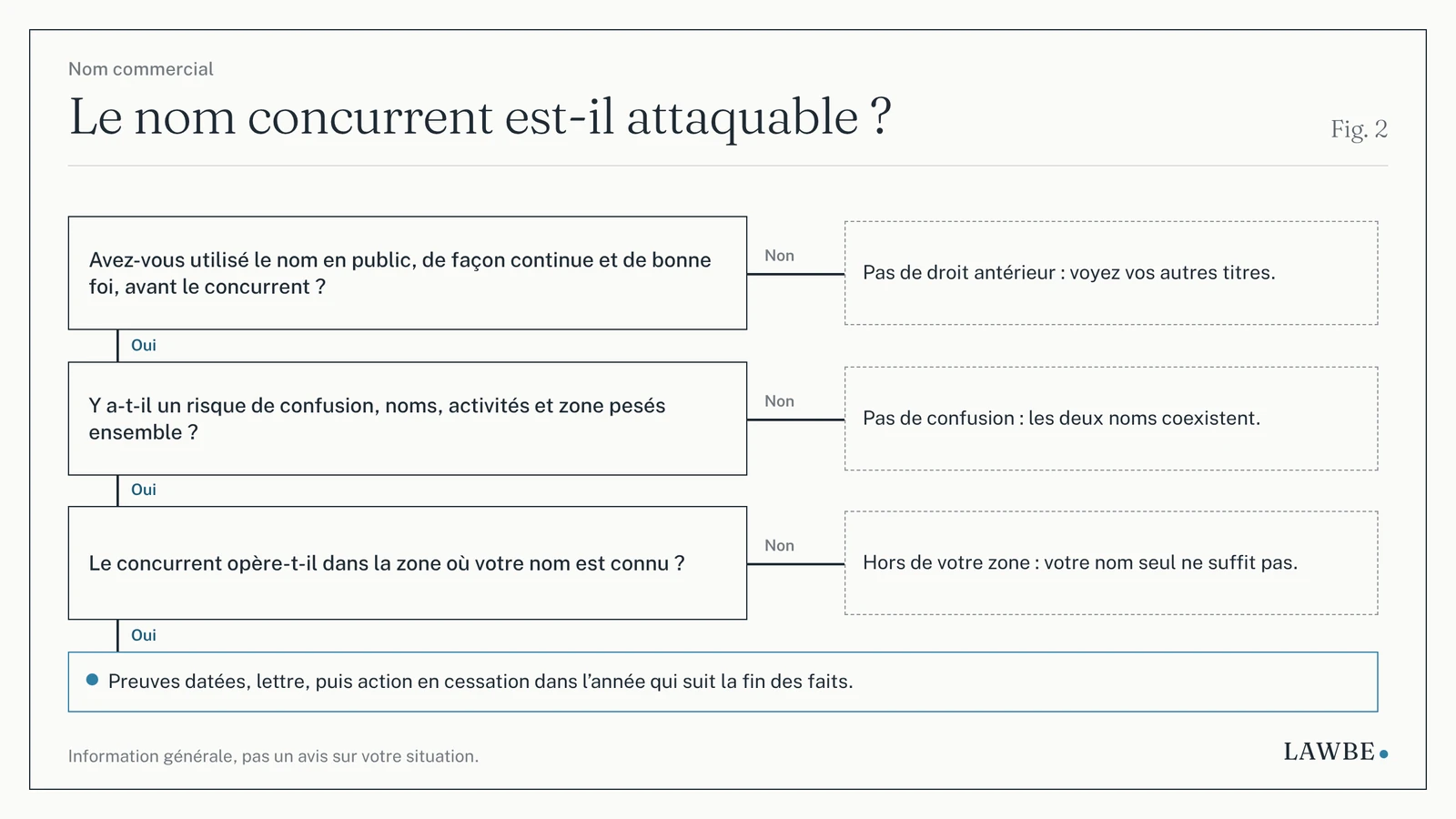
Then gather what dates your use: shopfront, press, advertising, invoices, correspondence.
None of the texts I have read on the cease-and-desist action requires a prior formal notice. In my view, the letter remains useful, because it dates what the competitor knew about your use.
A letter alone is not enough: a very late reaction to a name known for a long time can amount to an abuse of right. Against an EU trademark, a formal notice without binding steps does not interrupt acquiescence.
The cease-and-desist action is brought before the president of the Commercial Court (tribunal de l'entreprise), following the forms of summary proceedings. The judgment is provisionally enforceable, and the court may attach a periodic penalty payment to the prohibition. The action is no longer admissible one year after the facts end.
What I actually do
I first date your use of the name and the competitor's, then compare the names, the activities and the areas. I also consult the trademark registers and the BCE/KBO. You receive a written note: what your name allows, what a trademark would add, and the letter to send.
This work falls under the Trademarks and designs page. The "Check the name" range runs from 390 to 590 euros; "File and protect", in the Benelux or the Union, from 890 to 1,590 euros, plus official fees. "Defend" runs from 690 to 2,600 euros, plus fees. The exact price is given in writing after the first contact, which is free. Amounts excl. VAT.
Frequently asked questions
I am buying a business: can I keep its name?
In principle, yes: the buyer of a going concern may rely on the seller's first use, if the name has not been left unused for a long time.
Is a commonplace name protected?
Yes, but over a narrower territory, unless intensive advertising efforts have been made. The court may, however, refuse all protection to a name that lacks distinctive character.
Is my shop sign protected?
Yes: the shop sign, the sign displayed at your place of business, follows a regime close to that of the trade name.
How long do I have to act?
The cease-and-desist action is no longer admissible one year after the facts end. Damages are claimed, in principle, within five years of becoming aware of the harm and of the person liable, and at most within twenty years.
A name close to yours has just appeared, on the street or online. Write to me about your situation in three lines.
Sources
- Paris Convention for the Protection of Industrial Property, art. 8 (WIPO, publication no. 201(F)).
- Code of Economic Law (CDE), art. VI.104, VI.104/1, VI.105, 8°, XII.22, XVII.1/4, XVII.5, XVII.6, XVII.7 and XVII.23 (laws of 21 December 2013, NUMAC 2013011649, 2013011667 and 2014011018; law of 4 April 2019, NUMAC 2019011404; law of 21 April 2024, NUMAC 2024005024).
- Judicial Code, art. 1385bis (NUMAC 1967101055). Former Civil Code, art. 2262bis (NUMAC 1804032155).
- Code of Companies and Associations, art. 2:3.
- Benelux Convention on Intellectual Property, art. 1.16, 2.2, 2.2bis, 2.2ter, 2.14, 2.20 and 2.23 (Protocol of 11 December 2017, NUMAC 2018015720).
- Regulation (EU) 2017/1001 on the European Union trade mark, art. 7, 8(4), 60(1)(c), 61 and 138 (CELEX 32017R1001).
- CJEU, C-112/21, 2 June 2022 (CELEX 62021CJ0112); C-96/09 P, 29 March 2011, paragraphs 158 to 168 (CELEX 62009CJ0096); C-466/20, 19 May 2022 (CELEX 62020CJ0466).
- Cass., 21 June 1993, docket 7944; Cass., 8 December 2011, C.10.0198.N, Pas., 2011, no. 675.
- Brussels, 12 February 2013, R.G. 2012/AR/336, I.C.I.P.-Ing.Cons., 2013, p. 192; Brussels, 25 March 2024, Ing.-Cons., 2024, p. 298; Brussels, 4 May 2026, R.G. 2022/AR/837, I.C.I.P.-Ing.Cons., 2026, p. 529.
- Ghent, 20 December 2021, Ing.-Cons., 2021, p. 663; Ghent, 27 February 2023, R.G. 2022/AR/700, I.R.D.I., 2023, p. 157.
- Antwerp, 12 September 2019, R.G. 2018/AR/2322, D.A.O.R., 2020, no. 133, p. 112; Antwerp, 1 April 2020, R.G. 2019/AR/1563, I.R.D.I., 2020, p. 104.
- Liège, 27 October 2003, R.G. 2001/RG/1493, D.A.O.R., 2004, no. 69, p. 81; Liège, 26 April 2007, J.L.M.B., 2008, p. 155; Liège, 8 May 2008, Ing.-Cons., 2008, p. 675; Trib. entr. Hainaut, div. Tournai, 27 June 2019, Ing.-Cons., 2019, p. 627.
- J. Ligot, F. Vanbossele and J. Gosse, Les pratiques loyales, 3rd ed., Larcier-Intersentia, 2025, pp. 246 to 293; P. Maeyaert, De handelsnaam, Intersentia, 2021; H. Culot, G. de Pierpont, H. Jacquemin and Th. Léonard, Manuel du droit de l'entreprise, 5th ed.
- DNS Belgium, general terms and conditions, version 6.3, art. 10; Instagram, trademark infringement report form (consulted on 20 October 2026).
This article is general information, current as of 30 October 2026. It is not an opinion on your situation.
Translated from the French original published on 30 October 2026. The analysis concerns Belgian and European Union law. Read the French original.