
If a competitor has only taken your idea, your concept or your style, Belgian copyright law offers you, in principle, no remedy. It does apply, without any filing, if your original texts, visuals or videos have been reproduced in a recognisable way.
The essentials
The idea, the concept and the style remain free; only a concrete and original form is protected.
The right arises without filing, but you must prove authorship, the date and the elements taken.
Between businesses, copying remains permitted in principle, except in unfair circumstances.
After the copy: secure the evidence, report, send a formal notice, act quickly.
Is my copied idea protected by copyright?
No, as long as only the idea has been taken. Copyright protection extends "to expressions and not to ideas".
The Court of Cassation (Cour de cassation) specifies that it covers neither an idea or concept without form, nor a style, a fashion or a genre. Imagine a creator who posts a seasonal recipe filmed in one minute every week. Another account launches the same weekly slot: if it has taken neither her texts nor her images, it is in principle entitled to do so.
Saying that a concept is never protected would be too absolute: the author's intentions are protected only to the extent that the work expresses them.
What is protectable in a content concept?
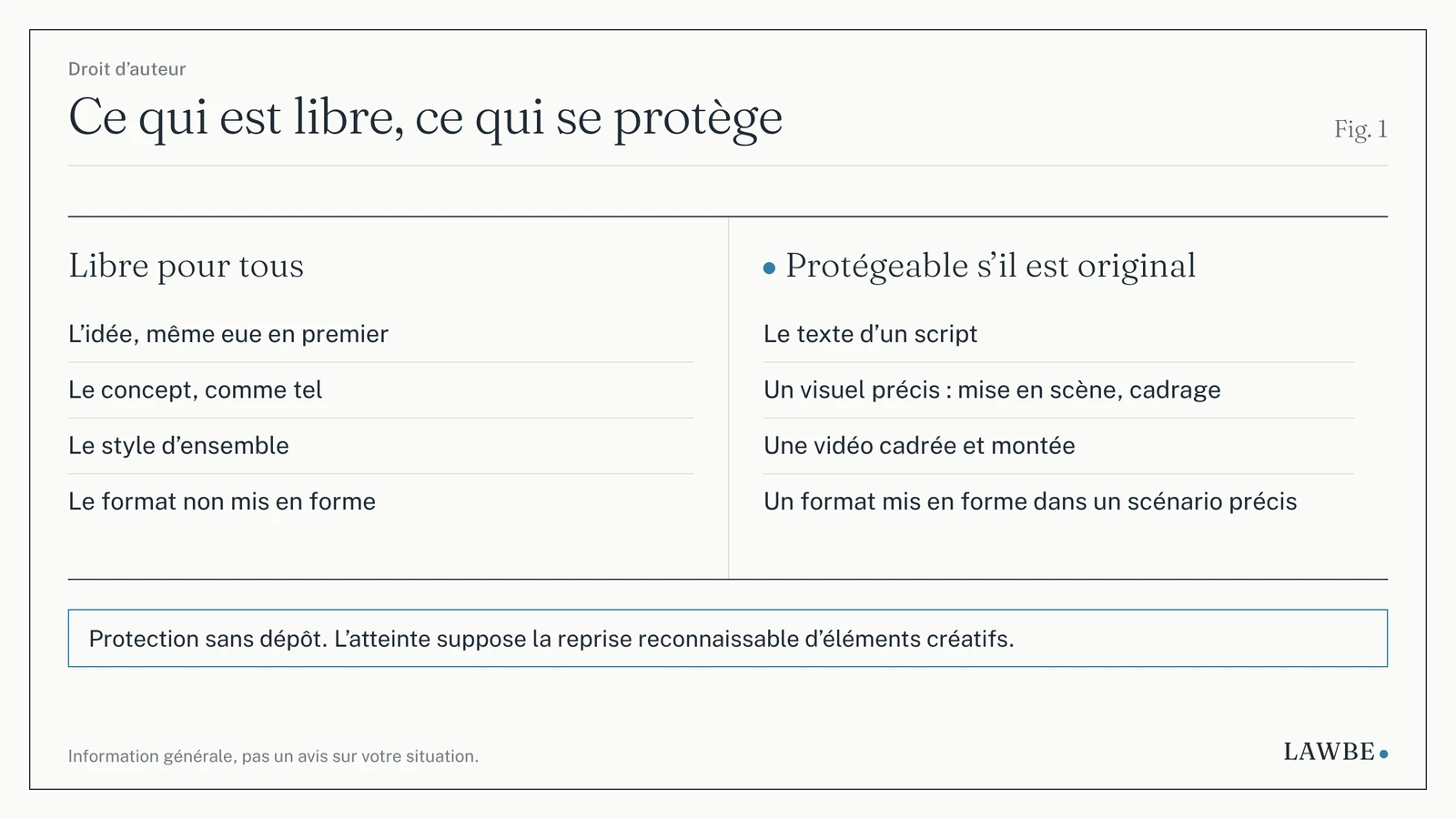
Each concrete and original element: the text of a script, a photo, an illustration, a framed and edited video. The author alone has the right to reproduce their work "in whole or in part" and to put it online.
An element is original when its author has made free and creative choices, such as the staging, framing or angle of a portrait photograph.
Answering that "the whole is different" is not enough: only the recognisable reproduction of creative elements counts.
A short text published online can be a work, its length being irrelevant. Intellectual effort alone does not count for originality: a year of work creates no right without an original form.
A series format becomes protectable if it is shaped into a precise scenario: staging, sequence of scenes, sets. Style only refers to features common to a body of productions, but its specific rendering can be protected.
| Element | Status | Condition |
|---|---|---|
| Idea | Free | Even if you had it first |
| Concept | Free as such | Only its concrete expressions are protected |
| Style | Free | Its specific rendering in a work can be |
| Format | Free in principle | Protectable if shaped into a precise scenario |
| Script text | Protectable | Free and creative choices, even if short |
| Specific visual | Protectable | Freely chosen staging, framing or angle |
| Editing | Protectable if original | Choices of framing and sequencing that bear the author's imprint |
Without a filing, how do I prove that I am the author?
Through your own documents, because copyright arises without any filing formality. You will have to establish who created, when, and which elements were taken.
The person who appears as such on the work or when it is communicated to the public, by their name or an identifying sign, is presumed to be the author, unless proven otherwise. So sign each post with your name.
The same article designates the natural person who created the work as the original rights holder. In my view, an agency or a brand must therefore be able to show how the rights of its creatives came to it. The logic is the same for code written by a freelancer.
Keep the genesis of each piece of content: successive files, briefs, dated versions. For a concept shown before its publication, the i-DEPOT of the Benelux Office for Intellectual Property (BOIP) proves the existence of your documents on the date of their receipt, without conferring ownership or a monopoly. According to the BOIP, its admissibility is a matter for the court of each country.
Can a competitor copy my concept without my content?
In principle yes, even between businesses. Article VI.104 of the Code of Economic Law (CDE) prohibits acts contrary to honest market practices by which a business harms the professional interests of another. It only operates at the margins of copyright.
Copying another's offer is permitted in principle, and profiting from their investments without creative effort is not in itself contrary to honest practices. On 2 March 2026, the Court of Cassation added that diverting the reputation of the party copied is not enough, on its own, to make the copy unlawful.
A further circumstance is required, such as a misleading or aggressive practice. So note what surrounds the copy: confusion maintained with your account, misled followers, systematic reproduction.
There must also be two businesses, that is, persons pursuing an economic purpose on a lasting basis. For the account that copies, this is a question of fact. If it is your name that is being taken, and not your content, see Protecting your trade name in Belgium.
What should I do as soon as I discover the copy?
Four steps, in this order: secure the evidence, report, send a formal notice, then act quickly if the copying persists.
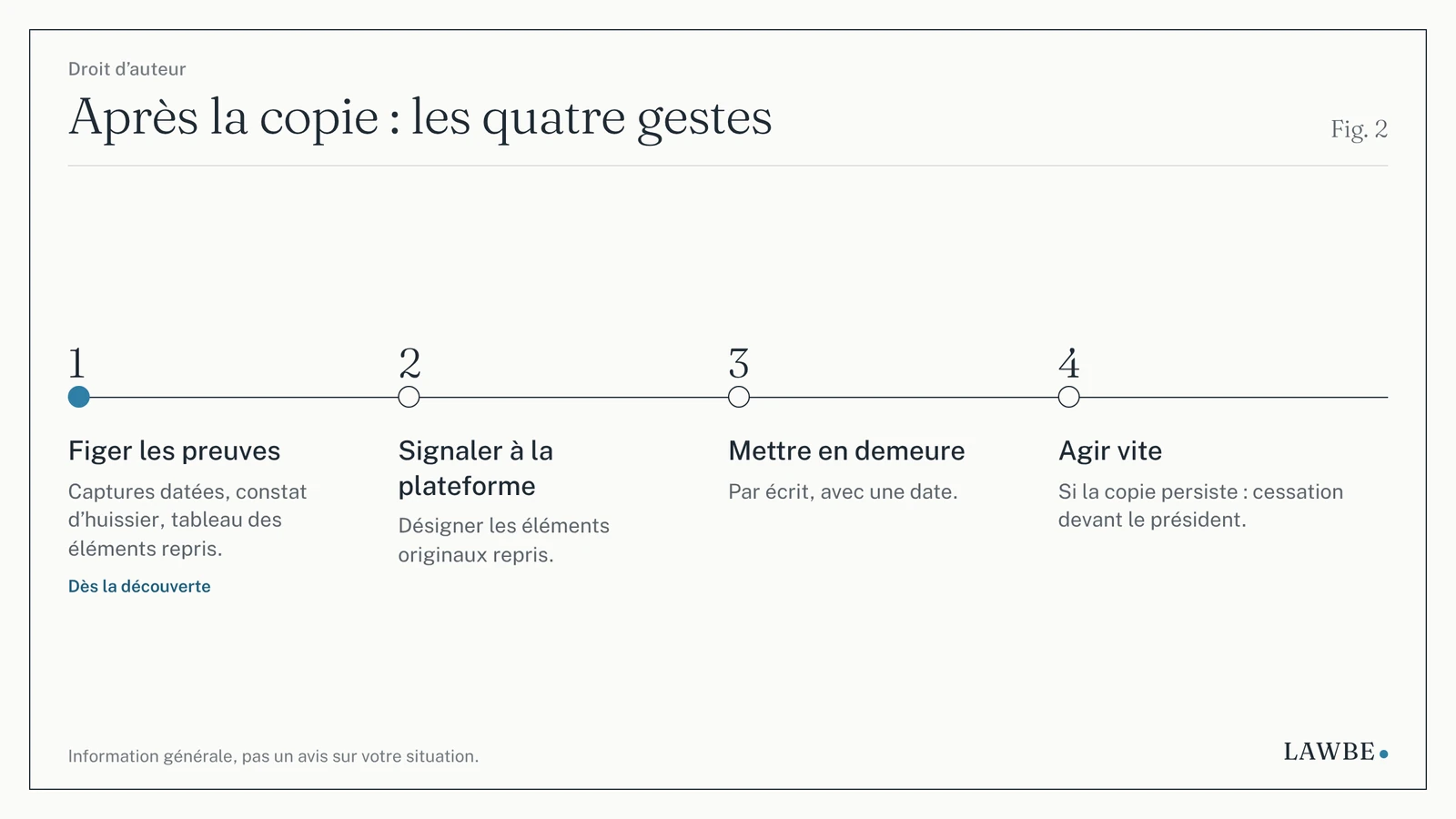
First secure the evidence: screenshots of the original and the copy, with the URL, the date and the account. A bailiff's report is authentic for the material facts the bailiff perceives directly. Draw up a dated table of the elements taken.
Then report the copy to the platform: a sufficiently substantiated explanation, the exact URL, your name, email address and a statement of good faith.
Identify the elements taken, because Instagram points out that copyright generally protects original expression, not ideas.
The account targeted may receive your contact details.
Then send a written and dated formal notice. None of the texts I have re-read requires it in order to act, but it dates the copier's knowledge of your work. And bad faith allows the court to order the transfer of all or part of the profit made from the infringement, and confiscation.
How long do I have to act?
For compensation, count in principle five years from the day after you became aware of the harm and of the person liable, and at most twenty years. According to one academic work, an action brought after four years of silence was held to be abusive.
If the copying persists, the president of the Court of First Instance or of the Commercial Court (tribunal de l'entreprise) may order it to cease.
Against a manifest and considerable online infringement, the president of the Brussels Commercial Court, who has sole jurisdiction, rules in principle within eight working days. This route requires a right that is "to all appearances, valid": if the protection of your concept is debatable, the ordinary cease-and-desist action seems to me more suitable.
What I actually do
I first compare your posts and those of the account that copies, to separate the trend from what has been reproduced as is. A written note then says what seems to me protectable and the route I consider proportionate, without announcing an outcome. The Protecting your work journey covers these steps upstream.
Depending on your choice, I draft the report, the formal notice or the application, services described on the Copyright page. The exact price is given in writing after the first contact, which is free.
Frequently asked questions
Does my publication date prove that I am the author?
Not on its own, because the statutory presumption rests on your name or an identifying sign.
Must a concept be filed to be protected?
No, copyright arises without filing. An i-DEPOT dates your documents without making you the owner of the concept.
Does the copier risk criminal prosecution?
Only a malicious or fraudulent infringement constitutes the offence of counterfeiting; taking an idea does not fall within it.
Can the copier claim homage or pastiche?
Pastiche presupposes an open and recognisable use of the work, for example a homage, and covers neither concealed imitations nor plagiarism.
A competitor has taken your scripts or your visuals? Write to me about your situation in three lines.
Sources
- TRIPS Agreement, art. 9(2) (CELEX 21994A1223(17)).
- Code of Economic Law, art. I.8, 39°, VI.104, VI.104/1, XI.165, XI.170, XI.293, XI.335, XVII.14 and XVII.34/1 (consolidated text, Justel, NUMAC 2013A11134).
- Judicial Code, art. 519, § 1, 2° (NUMAC 1967101053). Former Civil Code, art. 2262bis (NUMAC 1804032155).
- Regulation (EU) 2022/2065 on digital services, art. 16 (CELEX 32022R2065).
- Cass., 29 May 2009, C.06.0139.N (ECLI:BE:CASS:2009:ARR.20090529.1); Cass., 31 October 2013, C.12.0263.N (ECLI:BE:CASS:2013:ARR.20131031.1); Cass., 17 February 2017, C.15.0144.N (ECLI:BE:CASS:2017:ARR.20170217.1); Cass., 2 March 2026, C.23.0478.N (ECLI:BE:CASS:2026:ARR.20260302.3N.1).
- CJEU, C-145/10, 1 December 2011; C-469/17, 29 July 2019; C-580/23 and C-795/23, 4 December 2025; C-590/23, 14 April 2026; C-598/24, 3 September 2026.
- Benelux Convention on Intellectual Property, art. 4.4bis; BOIP pages on the i-DEPOT (consulted on 26 October 2026).
- Instagram and LinkedIn help pages on copyright (consulted on 26 October 2026).
- A. Berenboom, Le nouveau droit d'auteur, nos. 10 and 46; B. Michaux, "Style, mode et genre face au droit d'auteur", Auteurs & Media, 2022/1, p. 52; Droit des artistes, Larcier, no. 255, pp. 335 to 337.
This article is general information, current as of 30 October 2026. It is not an opinion on your situation.
Translated from the French original published on 30 October 2026. The analysis concerns Belgian and European Union law. Read the French original.