

For Black Friday, the crossed-out price is the lowest price you applied during the 30 days before the reduction. The percentage is calculated on that price. Cyber Monday does not reuse the old crossed-out price: it starts from the Black Friday price if that price is the lowest of the 30 days.
The essentials
Set the reference price of each product just before the reduction, channel by channel.
Recalculate it for Cyber Monday, Saint Nicholas and Christmas, because each campaign has its own.
Never cross out a manufacturer's recommended price.
Keep a history of your prices; without it, no calculation can be checked.
Which price do I cross out for a Black Friday reduction?
The crossed-out price is the lowest of all the prices you applied during the 30 days before the reduction. It is set just before the reduction applies.
The calculation is made per point of sale or selling technique: your webshop and each of your shops have their own reference price. A reduction limited to the shops therefore does not affect the webshop's reference price.
The Court of Justice of the European Union requires that the percentage, or a statement such as "price shock", be calculated on that prior price. A price presented as reduced therefore cannot be equal to or higher than that price.
A product sold for less than 30 days follows a reference period of at least 7 days.
Can Cyber Monday reuse the Black Friday crossed-out price?
No, each campaign has its own reference price, and every promotion in the previous 30 days counts, even one lasting a single day.
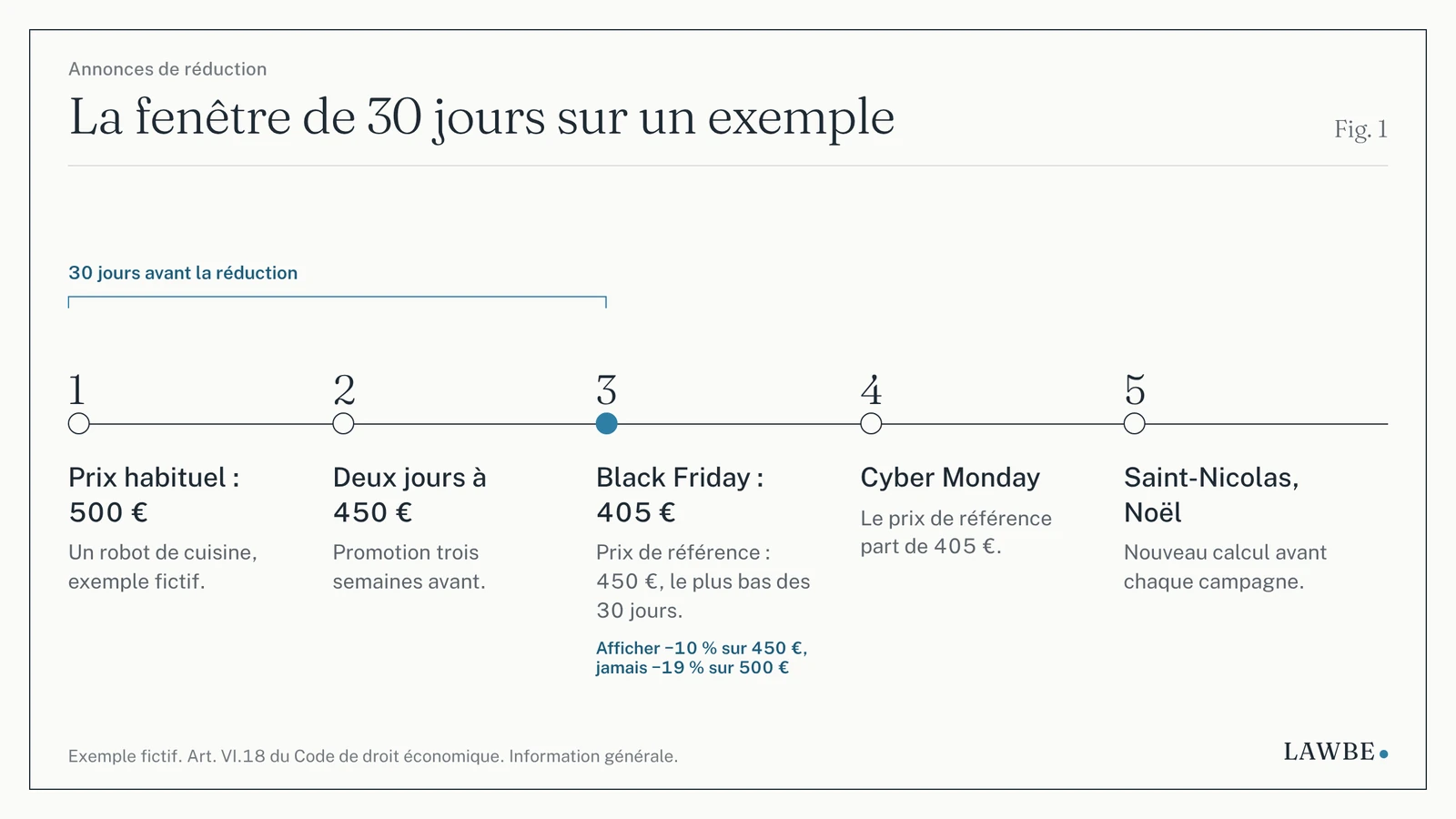
Here is a fictional example: a food processor sold at 500 euros had two days of promotion at 450 euros, three weeks before Black Friday. On Black Friday, its reference price is therefore 450 euros, the lowest of the 30 days. The food processor drops to 405 euros: the correct announcement is "-10%" on 450 euros, never "-19%" on 500 euros.
Cyber Monday then starts from 405 euros, and Saint Nicholas and Christmas both require a new calculation before each campaign.
Progressive reductions escape this recalculation for a single continuous campaign of 30 days at most. The legislator excluded from it a Black Friday followed by a Cyber Monday.
Can I cross out the recommended price or display "up to -70%"?
The manufacturer's recommended price cannot serve as the crossed-out price, because the reference price is your own. You may cite it as a comparison, without crossing it out or displaying a percentage, if it is actually applied in Belgium and clearly explained.
A launch price is not a reduction: it must actually be lower than the later price, for an announced period, preferably one month at most. It then counts towards the reference price.
A poster reading "up to -70%" or "Black Friday reductions" is an announcement of a price reduction, even without a price. The poster can do without a reference price, but each reduced item must carry its reduced price and its reference price, in the shop as online. The "up to" becomes misleading if the maximum rate only applies to a few items.
| Type of announcement | What serves as the reference price | Risk |
|---|---|---|
| Crossed-out price or "-20%" on a product | Your lowest price of the 30 days, on that channel | Percentage calculated on a higher price |
| New reduction on Cyber Monday | The Black Friday price, if it is the lowest of the 30 days | Reusing the old crossed-out price |
| Product sold for less than 30 days | Your lowest price over at least 7 days | Announcing a reduction as soon as the product goes on sale |
| Manufacturer's recommended price | None: comparison only, no crossing out, no percentage | Crossing it out as your own price |
| Launch price | None: it is not a reduction | Presenting it as a discount |
| Poster "up to -70%" without a price | None on the poster; each item carries its own | Maximum rate reserved for a few items |
I sell on a marketplace: who is liable for the crossed-out price?
You, in principle: the rule targets the business that announces the reduction and the price it has itself applied. According to the European Commission, a platform that only provides the selling tool is not liable for it, unless it sells itself or on behalf of another trader.
Since 14 August 2026, the platform must tell the consumer, before the contract, whether the third-party seller is a business and how the obligations are divided. Its interface must also allow you to display the required information.
A seller established outside the Union follows the same rule when it directs its sales at consumers in the Union.
Does the waiting period before the sales apply to Black Friday?
Black Friday follows the 30-day rule, like any reduction, whereas the seasonal sales have their own regime. The waiting period only covers clothing, leather goods and footwear: there, it prohibits reductions that take effect in the month before the sales.
The winter sales start on 3 January, or on 2 January if the 3rd falls on a Sunday.
As 3 January 2027 is a Sunday, the winter sales will start on 2 January: the waiting period will run from 2 December 2026 to 1 January 2027. Black Friday and Cyber Monday fall before it, Saint Nicholas within it.
On 20 May 2026, the Council of State (Conseil d'État) held article VI.25 on the seasonal sales to be contrary to Directive 2005/29/EC and annulled three administrative fines. The judgment approves an analysis that makes the waiting period an inseparable element of the sales.
No law had amended these two articles as of 22 October 2026.
The waiting period therefore remains in the text, but its sanction is fragile, and I advise complying with it as a precaution.
What do you risk in the event of an inspection?
Failing to comply with the 30-day rule exposes you to a level 2 sanction; misleading on the price, to level 3, or even 4 in the event of bad faith.
The fine can reach 4% of annual turnover at level 2 and 6% at levels 3 and 4, if that amount exceeds the ceiling in euros.
A warning may first set a deadline for ending the infringement. Your undertaking to stop and to compensate the customers affected, if accepted, can close the enforcement action.
During the European operation of November and December 2025, the Economic Inspectorate found infringements in 16 of the 23 businesses targeted.
Videos by creators that announce your promotions follow the same rules on commercial practices: see UGC videos: when the advertising disclosure is required.
Your customer can report the announcement on ConsumerConnect and, if misled on the price, the court may order a refund without return of the goods.
What should I do before launching the campaign?
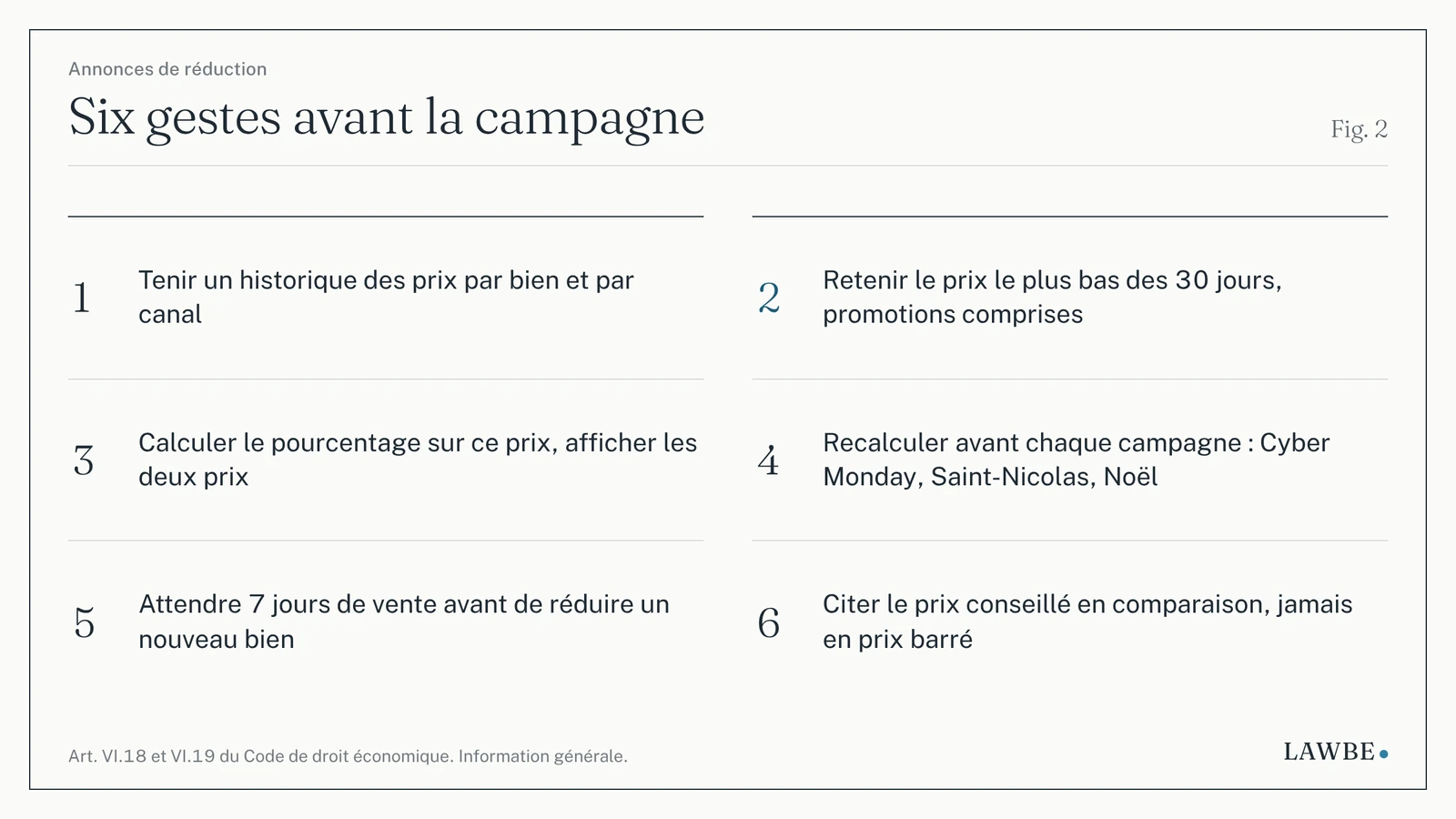
Before going live, make these six checks:
- Keep a price history per product and per channel.
- Take the lowest price of the 30 days, promotions included.
- Calculate the percentage on that price, display both prices.
- Recalculate before each campaign: Cyber Monday, Saint Nicholas, Christmas.
- Wait 7 days of sales before reducing a new product.
- Cite the recommended price as a comparison, never as a crossed-out price.
What I actually do
Before a campaign, I re-read your standard announcements: product page, banner, email, promo code. I check with you the method for calculating the reference price, channel by channel, and I give you a short note of the corrections to make.
This review falls under the "review" range of the Contracts page, from 490 euros. Drafting your general terms and conditions of sale runs from 390 to 2,300 euros, and my guide to general terms and conditions lays the groundwork. The exact price is given in writing after the first contact, which is free. Amounts excl. VAT.
Frequently asked questions
Do the crossed-out price rules apply to services?
No: since 17 May 2026, the 30-day rule only covers tangible movable goods.
A misleading reduction on a subscription remains prohibited.
Does a promo code count as an announcement of a price reduction?
Yes, according to the FPS Economy, when it is visible to everyone or linked to a customer card that is easy to obtain.
Must a "buy one, get one free" comply with the 30-day rule?
The FPS Economy places it outside this rule, like other conditional offers. The condition must nevertheless be genuine, otherwise the offer becomes an ordinary announcement of a price reduction again.
Are fresh products concerned?
The prior price rule excludes goods that deteriorate or expire rapidly. A misleading announcement about their price remains prohibited.
Your end-of-year campaign is being prepared now: Write to me about your situation in three lines.
Sources
- Code of Economic Law (CDE), art. I.1, VI.18, VI.19, VI.25, VI.29, VI.38, VI.44/3, VI.97, XV.31, XV.70, XV.83 and XV.85 (consolidated text, Justel, NUMAC 2013A11134); law of 20 April 2026, art. 3 and 4 (NUMAC 2026003265).
- Explanatory memorandum to the law of 8 May 2022, Doc. parl., Chambre, no. 55-2473/001, p. 23.
- FPS Economy, "Guidelines: announcements of price reductions", version of 9 February 2026; press release of 26 March 2026 on the inspection of online promotions.
- CJEU, C-330/23, 26 September 2024 (ECLI:EU:C:2024:804).
- European Commission, guidance on article 6a of Directive 98/6/EC (CELEX 52021XC1229(06)); Regulation (EU) 2022/2065, art. 31.
- Council of State, 20 May 2026, nos. 266.735 to 266.737.
This article is general information, current as of 30 October 2026. It is not an opinion on your situation.
Translated from the French original published on 30 October 2026. The analysis concerns Belgian and European Union law. Read the French original.