

Paying a creator, or giving them the product, so that they taste it and say "this is so good" is permitted. The video must then be recognisable as advertising from the first seconds, and tell the truth. Without a clear disclosure, or disguised as a customer's opinion, it becomes a misleading commercial practice for which the brand is liable first.
The essentials
A product given in connection with the post, or an invitation, requires the disclosure, even without payment or a written contract.
Write "Advertising" on screen from the first seconds and at the top of the description.
Never present a paid creator as an ordinary customer, nor their video as a review.
Put the disclosure, sincerity and the permitted claims in the creator's contract.
Is a paid UGC video, or a free product, advertising?
Yes, as soon as the creator receives something in connection with the post. Advertising is any communication that aims, directly or indirectly, to promote the sale of products.
The consideration can be in kind. The Flemish media regulator reasoned the same way for a creator invited free of charge, without a contract or any obligation to post.
A parcel sent without instructions remains debated: disclose as a precaution. A customer who spontaneously films her jar of granola has nothing to disclose, because the definition in Book XII excludes communications produced independently.
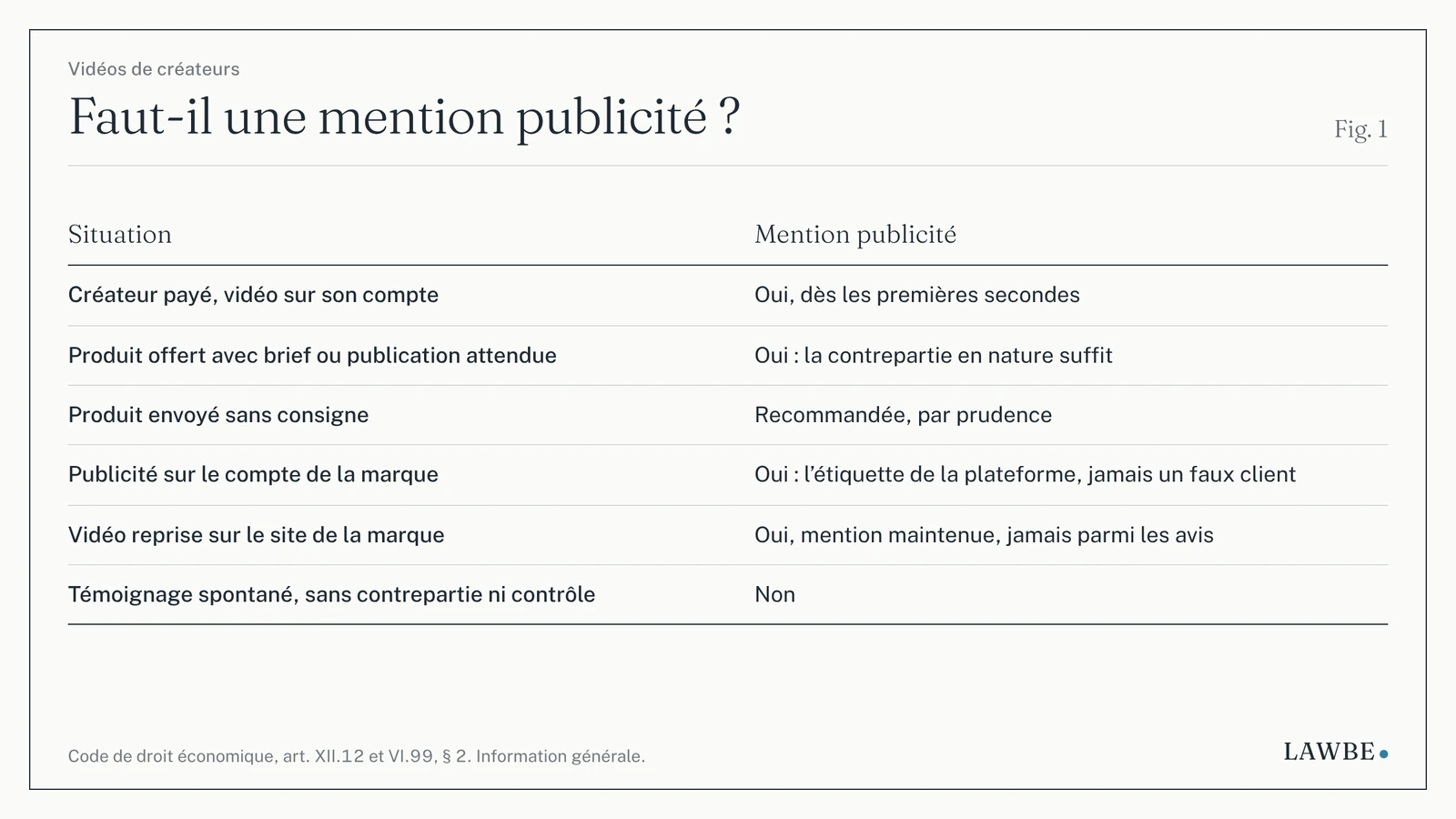
| Situation | Disclosure needed? | Why |
|---|---|---|
| Paid creator, video on their account | Yes, from the first seconds | Payment creates a commercial intent |
| Product given with a brief or an expected post | Yes | Consideration in kind is enough |
| Product sent without instructions | Recommended | The link with the video is debatable |
| Advertising on the brand's account | Yes, the platform's label | It signals the origin, not a staged customer |
| Video reused on the brand's website | Yes, disclosure kept | Never among customer reviews |
| Spontaneous testimonial, without consideration or control | No | Independent opinion, no link with the brand |
Which disclosure should I use, and where should it go?
Write "Advertising", or "Paid partnership with" and the brand's name, on screen from the first seconds and at the top of the description. Advertising must be identifiable "upon receipt", or otherwise carry the word "advertising" in a legible, prominent and unequivocal way. The advertiser must also be clearly identifiable.
An ambiguous or badly timed disclosure makes the video misleading if the commercial intent is not apparent from the context and the disclosure could influence the purchasing decision.
Hashtags at the end of the text, a disclosure hidden behind "see more" and a mere tag are not enough. The Flemish regulator also rejected "Invitation" and "thanks to", as the platform's "paid partnership" feature had not been activated.
Activate this feature without relying on it: according to legal writing, the platform's obligation does not exhaust the trader's. Write the disclosure in the language of the audience, on each post.
When does "this is so good" become misleading?
It becomes misleading when enthusiasm is passed off as a fact, a test result or an invented experience. On its own, "Mmm, this is so good" remains an accepted exaggeration: legal writing extends the statutory reservation for "exaggerated statements" to all consumers.
"The best taste tested" or "preferred by nine customers out of ten" refer to tests. False information about their results is misleading if it could steer the purchase. The Brussels Court of Appeal tolerated an obvious exaggeration for a vegetable drink, but held a false figure-based claim to be misleading.
For a food product, it is also prohibited to attribute to its composition objective or measurable properties that cannot be demonstrated. Nutrition and health claims also fall under a European regulation.
You must be able to prove "the material accuracy of the factual data", otherwise the court may treat it as inaccurate. A creator who has not tasted the product, or who reads a script presented as their own feeling, misleads through the overall presentation of the video.
Can the creator present themselves as an ordinary customer?
No: falsely presenting oneself as a consumer is prohibited in all circumstances. One author describes the influencer's persona as "the result of staging work designed to produce the appearance of spontaneity".
A briefed video cannot call itself an "independent test" or an "unsponsored review" either, because misleading about the motives of a practice makes it misleading. In advertising on your own account, the platform's label indicates the origin. In my view, it does not cure either a staged ordinary customer or the original post left without a disclosure.
Keep commissioned videos out of your customer reviews: commissioning someone to send false consumer recommendations, or distorting reviews, is prohibited in all circumstances. A spontaneous review that is reused must remain faithful.
Who is liable: the brand, the creator or the agency?
The brand is liable first: "The principals are therefore responsible for the advertising". The cease-and-desist action against unfair advertising is directed only at the advertiser.
The creator is also liable if they pursue an economic purpose on a lasting basis. Frequent partnerships may be enough; an occasional creator is deemed to act in the name of the brand, which is liable together with them. They must identify the advertising even when the content is dictated to them.
In Flanders, according to the media regulator, a creator who informs or entertains their audience also falls under the Media Decree, which requires commercial communication to be readily identifiable.
The regulator, which can warn or impose a fine, warned a creator on 9 December 2024.
The agency has no specific text of its own and remains liable, like any business, for what it designs. If the advertiser is not domiciled in Belgium and has designated no one responsible there, the action may target other persons. The law ranks them in this order: the publisher or producer, then the director, then the distributor and anyone who knowingly contributes to the effect of the advertising.
A competitor or a consumer association may also seek a cease-and-desist order.
What should the contract with the creator contain?
Five clauses translate these rules into obligations for the creator and give you the means to control the campaign, then to prove what was agreed.
| Clause | What the contract provides |
|---|---|
| Disclosure | "Advertising" from the first seconds and at the top of the description, feature activated, on each post |
| Sincerity | Genuine tasting, own opinion, right to refuse; never the role of an ordinary customer |
| Claims | Closed list; nothing nutritional, health-related or comparative without written agreement |
| Usage rights | Media, duration, territory; disclosure kept; never among customer reviews |
| Proof and control | Brief, script, rushes kept; review before posting; removal on request |
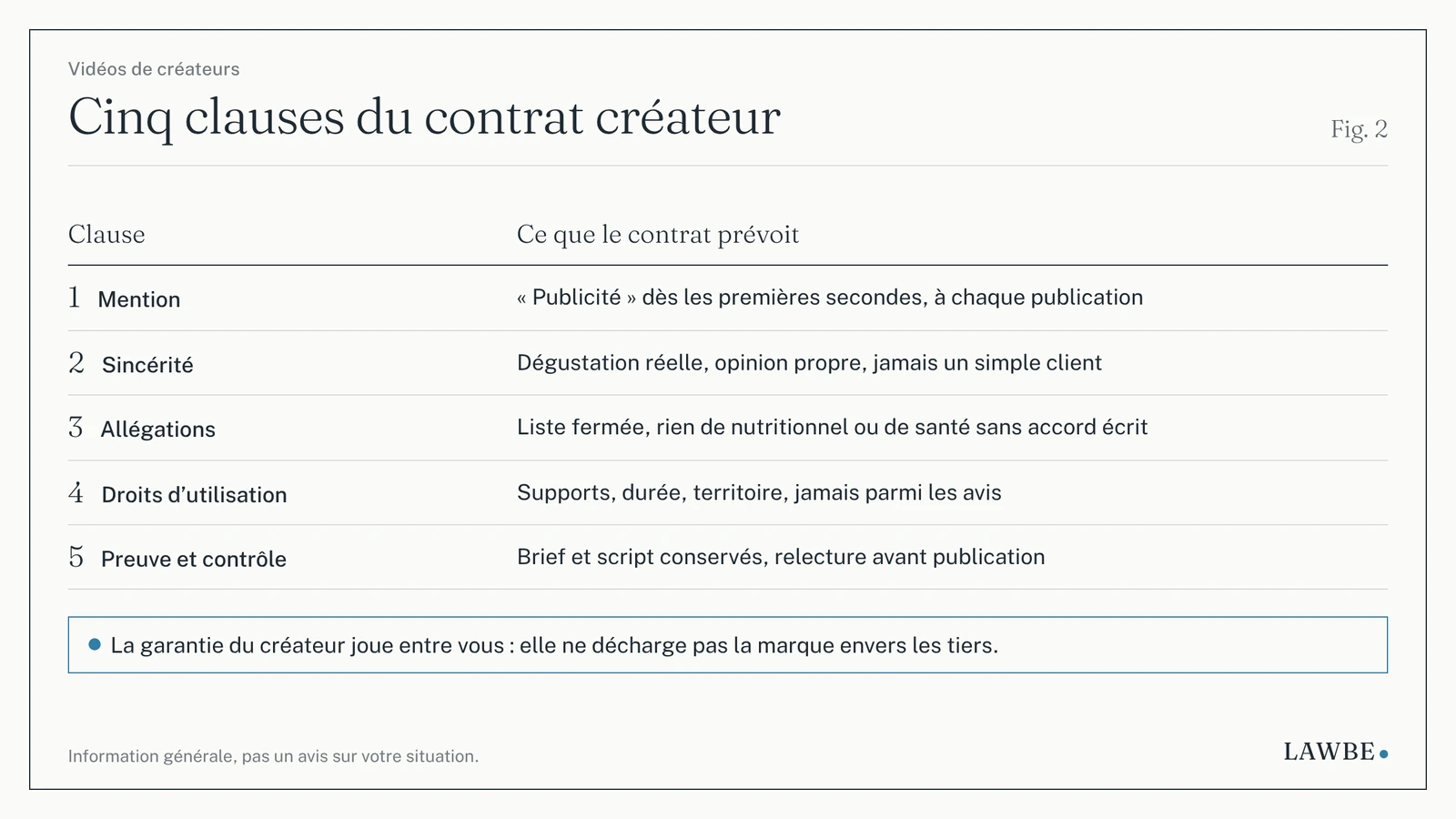
Have the creator warrant the disclosure. In my view, this warranty only operates between you: the cease-and-desist action remains directed at the advertiser. For their rights in the videos, see Copyright, where the first contact is free.
What I actually do
Before a campaign, I re-read your brief, your creator contract and the disclosures planned for each platform. I check that the claims in the script hold up against your product pages and your general terms and conditions of sale. I then draft the template contract that you will reuse with each creator.
On the Contracts page, reviewing a contract costs from 490 euros. The exact price is given in writing after the first contact, which is free. Amounts excl. VAT.
Frequently asked questions
Does a free product, without payment, require a disclosure?
Yes, as soon as it is linked to the post. The Flemish regulator so held for an invitation, without a contract or any obligation to post.
Is the hashtag #ad at the end of the description enough?
No, legal writing considers hashtags placed at the end of the text insufficient. Place the disclosure at the top.
Who is liable if the creator forgets the disclosure?
The brand first, because the cease-and-desist action targets the advertiser.
Can I display UGC videos among the customer reviews on my website?
No, passing off commissioned videos as consumer recommendations is prohibited in all circumstances.
A campaign with creators is framed before the first shoot. Write to me about your situation in three lines.
Sources
- Code of Economic Law (CDE), art. I.8, 13° and 39°, I.18, 6°, VI.93, VI.97, VI.99, § 2, VI.100, 22° and 26°, XII.12, XV.16, XVII.7, XVII.10 and XVII.13 (consolidated text, Justel, NUMAC 2013A11134; laws of 21 December 2013, 15 December 2013, 26 December 2013, 15 April 2018, 8 May 2022 and 22 July 2026).
- Flemish Media Decree of 27 March 2009 (Mediadecreet), art. 2, 26°, 53 and 228 (NUMAC 2009035356).
- Royal decree of 17 April 1980 on advertising for foodstuffs, art. 4 (NUMAC 1980041701); Regulation (EC) No 1924/2006 (CELEX 32006R1924).
- Vlaamse Regulator voor de Media, 9 December 2024, decision no. 2024/069.
- Brussels, 8 May 2008, R.D.C.-T.B.H., 2009, p. 809.
- T. Heremans and E. Le Grelle, "Médias sociaux", in Droit du marketing, Larcier, 2023, pp. 291 to 313; J. Ligot, F. Vanbossele and J. Gosse, Les pratiques loyales, 3rd ed., Larcier-Intersentia, 2025; E. Defreyne, "Les influenceurs virtuels sur les réseaux sociaux", R.D.T.I., 2025/3, p. 132.
This article is general information, current as of 30 October 2026. It is not an opinion on your situation.
Translated from the French original published on 30 October 2026. The analysis concerns Belgian and European Union law. Read the French original.