

An unpaid service provider may suspend its services until the client pays or offers to pay, without going before a court. You still have to remain in good faith and proportionate: poorly calibrated, the suspension becomes your own breach.
The essentials
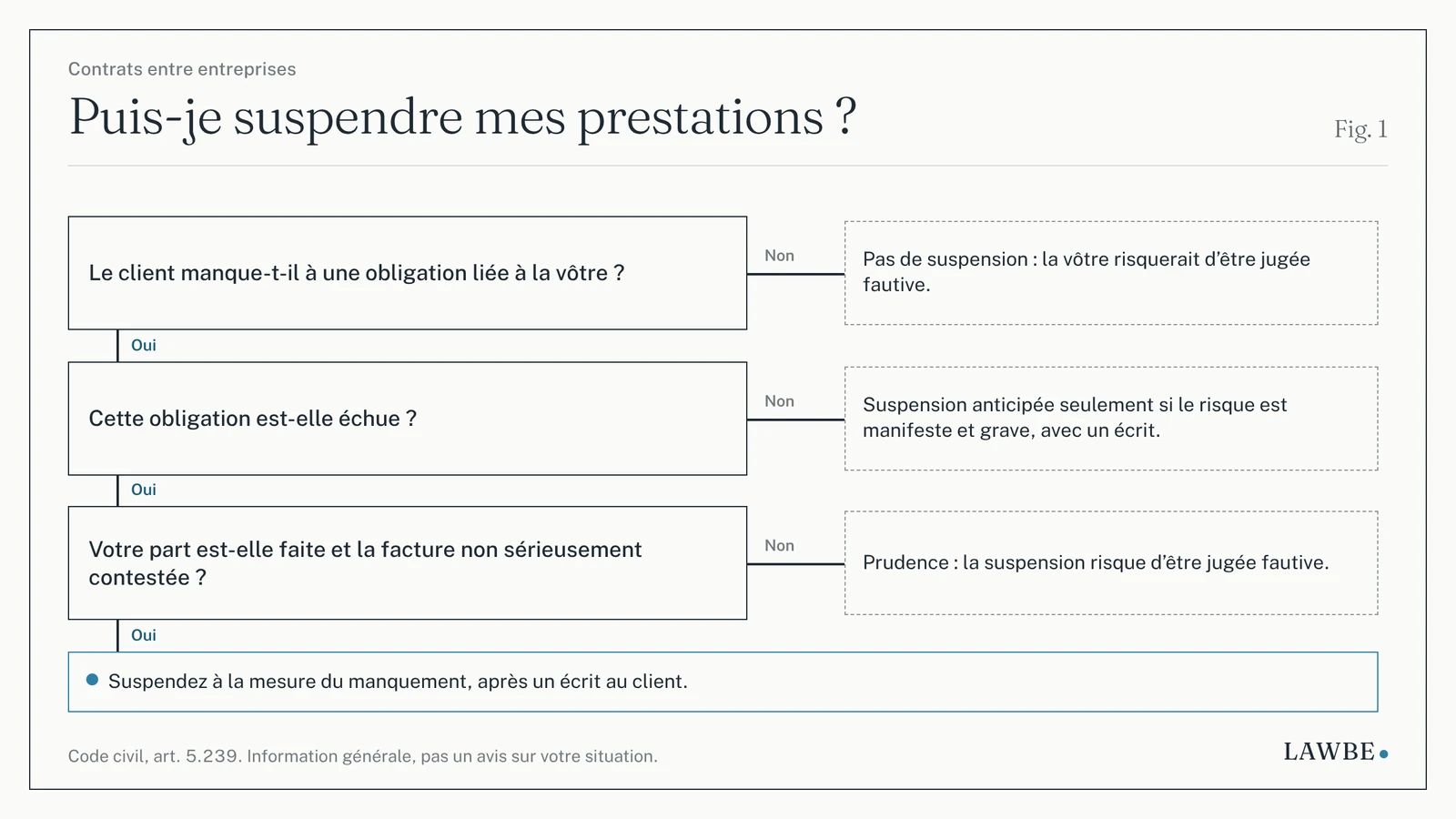
You may suspend if the invoice is due, linked to the service you are stopping and not seriously disputed.
Stopping new work exposes you less than cutting off the client's access to its data.
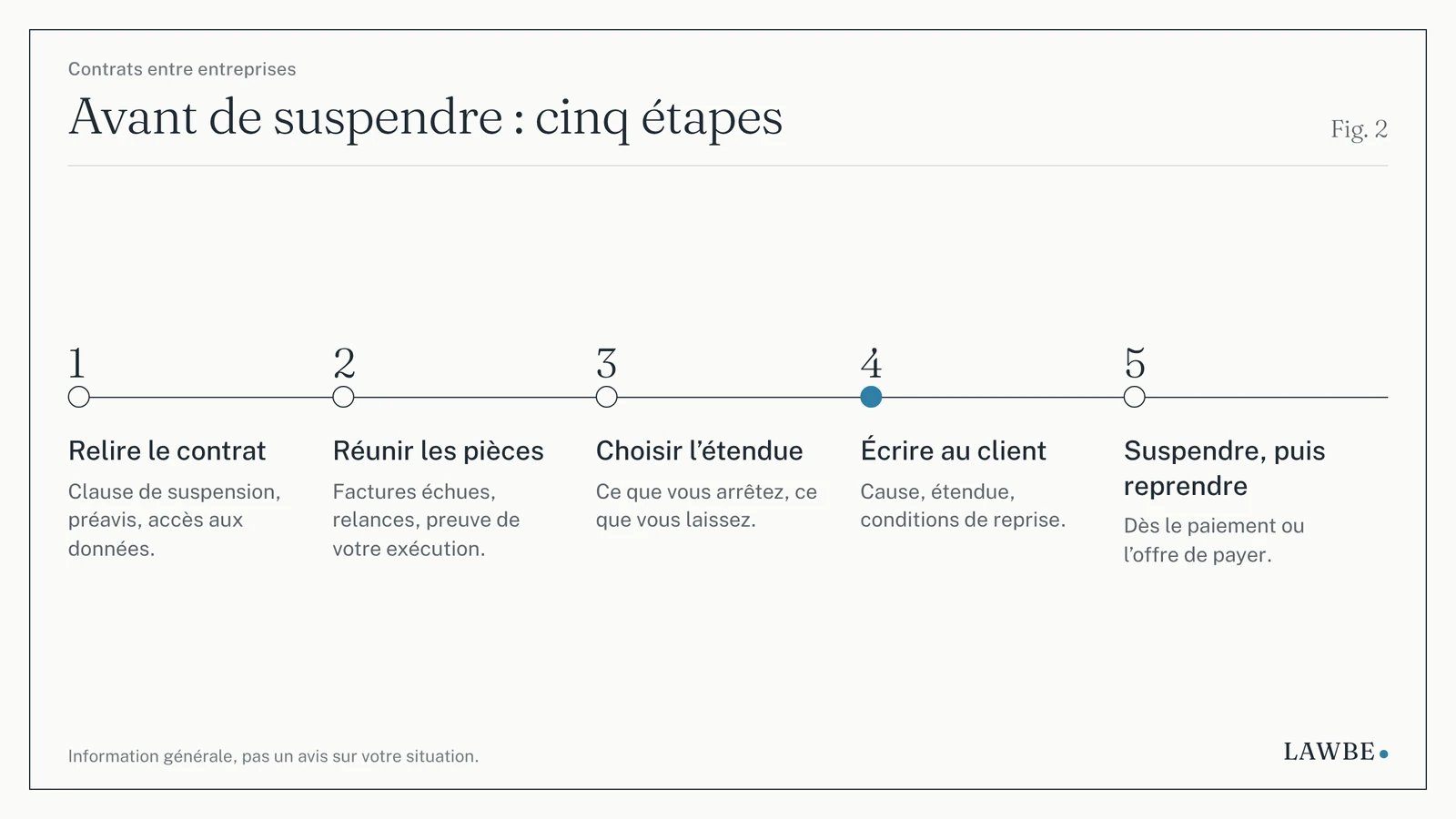
Write to the client before suspending: cause, scope, conditions for resuming.
If your supplier suspends, a precise written offer to pay ends the suspension.
Can I stop working for a client who does not pay?
Yes, when their payment and your service depend on each other: the Court of Cassation (Cour de cassation) already accepted that a party may suspend its own undertaking "without judicial authorisation".
Lawyers call this the defence of non-performance (exception d'inexécution), enshrined in article 5.239 of the Civil Code since 1 January 2023.
Suspending does not bring the money in. For the unpaid invoice itself, see how to recover a debt between businesses.
What conditions must I meet, and what must I prove?
Six cumulative conditions apply, and a written notice is added in two cases. The table gives, for each, the document that proves it.
| Condition | What you must be able to prove |
|---|---|
| The client's obligation is linked to your service | The contract, the signed quote or the purchase order |
| It is due | The invoice and its due date, or the date set for their part |
| The breach already exists | For non-payment, nothing: it is for the client to prove payment. For a poorly performed part, its non-conformity |
| You did not cause it | That you delivered your part and answered their requests |
| The invoice is not seriously disputed | The absence of a complaint, or your written answer to each grievance |
| The suspension remains proportionate | What you stop, what you leave the client, and why |
| A prior written notice, in two cases | The email or registered letter: date, cause, circumstances |
The court checks that the suspension stays within the limits of the link between the obligations. For a licence and hosting signed separately, that link is shown, in my view, by cross-references between the contracts or by an overall price.
The debt must be certain and due, even if its exact amount remains to be fixed. A serious dispute therefore weakens the suspension.
The breach must come from the client. In Brussels, the Court of Appeal refused the defence to building owners who had themselves hindered the resolution of the outstanding remarks.
As for proof, the client shows that it paid or offered to pay; if you criticise a poorly performed part, proving the non-conformity is up to you.
How far can I suspend without committing a breach myself?
As far as the breach justifies. There is no seriousness threshold: a non-performance attributable to the client is enough.
The limit comes from good faith: the Civil Code prohibits abusing contractual rights.
Take a design agency whose client has not paid the second instalment. It may stop the new mock-ups; taking down the website already delivered and paid for would expose it to a charge of disproportion.
Without these conditions, the suspension itself becomes a breach. The client may then claim performance, damages, or even termination at your fault.
Must I warn the client before suspending?
Yes, in two cases: when the client's obligation is not yet due, and when good faith requires it. The written notice is then sent without undue delay and states the cause and the circumstances of the suspension.
In the other cases, write anyway: the email fixes the date, the cause and the scope of the suspension.
You may even suspend before the due date if it is clear that the client will not pay and the consequences would be serious enough for you. Sufficient assurances from the client end it.
Before suspending, the order matters. Re-read the contract, gather the overdue invoices, your reminders and the proof of your performance, then choose the scope of the stoppage. Then write to the client, suspend, and resume as soon as payment or an offer to pay arrives.
IT or SaaS provider: can I cut off access?
In my view, stopping development or support is easier to defend than cutting off access. The Mons Court of Appeal accepted that a supplier block the completion of an automation project as long as undisputed invoices remained due.
Withholding data exposes you more. After a ransomware attack, a provider refused to migrate a medical practice's data as long as a disputed invoice remained unpaid. According to the published commentary, the judge in summary proceedings held this refusal to be abusive.
The commentator of that decision weighs the sensitivity of the data, the access left to the client and the weight of the invoice.
My recommendation: a graduated suspension, from support towards access, without ever holding the data as security. Provide in the contract for access to the data during suspension, and re-read the frequent mistakes in SaaS contracts.
What is the suspension clause in my contract worth?
It prevails in principle: the remedies for non-performance, suspension included, apply "unless the parties agree otherwise". A clause may therefore set a notice period, tiers or immediate suspension.
Between businesses, the law presumes abusive a clause that excludes or limits "inappropriately" your statutory rights in the event of the other party's non-performance. The rule applies to contracts concluded, renewed or amended since 1 December 2020.
A clause authorising you to cut off "immediately and without notice" does not exempt you from good faith.
Towards a consumer, a clause that obliges the consumer to pay while you do not perform is abusive in all circumstances; see the guide to general terms and conditions.
My supplier has suspended its services: how should I react?
Make a written offer to perform, precise and in line with what is owed: the suspension only lasts until your payment or your offer. Before the due date, the supplier had to write to you, and sufficient assurances on your part lift it.
Also go through the table from your side: each missing condition is an argument.
Faced with an unjustified suspension, send a clear and unequivocal formal notice, then claim specific performance or compensation for your loss.
In an emergency, apply to the judge in summary proceedings. A judge in summary proceedings thus held the withholding of the medical practice's data to be abusive.
What I actually do
Before a suspension, I re-read your contract and your general terms and conditions, I check each condition and I draft the notice to the client with you. The starting point is the 45-minute scoping call, prepaid, 120 euros, on the Business law page. Chasing an unpaid invoice is listed there from 290 euros; a dispute is subject to a quote and a cap per phase.
For what follows, I rewrite your clauses (Contracts): review from 490 euros, drafting general terms and conditions 390 to 2,300 euros, equipping a SaaS 3,500 to 4,900 euros.
The exact price is given in writing after the first contact, which is free. Amounts excl. VAT.
Frequently asked questions
Must I send a formal notice before suspending?
No, the Civil Code only requires it for the other remedies for non-performance. A written notice remains required before the due date, or when good faith demands it.
How long can the suspension last?
Until the client performs or offers to perform: the suspension pauses the contract without ending it.
My client is in judicial reorganisation: can I suspend?
The procedure does not end the contract. If your client itself suspends its obligations during the moratorium, you may suspend yours, without terminating on that ground alone. For another breach during the moratorium, the law does not settle the question: have your situation checked before suspending.
Does my client's bankruptcy prevent me from suspending?
No: according to the Court of Cassation, bankruptcy does not deprive the other party of the defence of non-performance.
A client has stopped paying, or a supplier has cut off your access. Write to me about your situation in three lines.
Sources
- Civil Code, Book 5, art. 5.73, 5.83, 5.231, 5.234, 5.237 and 5.239 (law of 28 April 2022, NUMAC 2022032058; consolidated text, Justel, NUMAC 2022A32058).
- Code of Economic Law (CDE), art. VI.83, 9°, VI.91/5, 4°, and XX.56 (consolidated text, Justel, NUMAC 2013A11134); law of 4 April 2019, art. 39 (NUMAC 2019011404).
- Judicial Code, art. 584 (NUMAC 1967101054).
- Cass., 24 September 2009, C.08.0346.N; Cass., 12 September 1986, docket 4933.
- Brussels, 3 February 2023, 2020/AR/1634 (ECLI:BE:CABRL:2023:ARR.20230203.1); Mons, 21 March 2023, 2021/RG/544.
- A. Cataldo, "La rétention des données au titre de l'exception d'inexécution", R.D.T.I., 2017, no. 66-67, p. 183.
- P. Wéry, "Le Livre 5 du Code civil. Les sources des obligations", Rép. not., vol. IV, Larcier, 2024, nos. 622 to 624; B. Kohl and F. Onclin, "La vente. Théorie générale", Rép. not., vol. VII, Larcier, 2024, no. 308.
This article is general information, current as of 30 October 2026. It is not an opinion on your situation.
Translated from the French original published on 30 October 2026. The analysis concerns Belgian and European Union law. Read the French original.