

A client established in another EU country is not paying an invoice of 5,000 euros or less. The European small claims procedure lets you obtain a judgment in writing, without a mandatory lawyer, which can then be enforced throughout the Union.
The essentials
The procedure covers a civil or commercial claim of 5,000 euros at most, excluding interest and costs. At least one party is established in an EU country other than that of the court.
It decides the case even if your client disputes the invoice, on the basis of your written evidence, with time limits of fourteen and thirty days.
If your client does not dispute the claim, other routes are faster: the European order for payment or, between businesses in Belgium, recovery by a bailiff.
The test tells you in two minutes whether the procedure is open to you, and which route to look at if it is not.
When is the small claims procedure open?
Four conditions must be met. The claim is a civil or commercial matter. It does not exceed 5,000 euros when the court receives the claim form, excluding interest, expenses and disbursements.
The dispute is cross-border: at least one party is domiciled or habitually resident in a Member State other than that of the court seised. This is assessed on the day the court receives the form. Denmark does not apply the procedure.
Finally, the matter is not excluded. The Regulation excludes, among others, insolvency, social security, arbitration, employment law, tenancies of immovable property other than money claims, and violations of privacy.
| Condition | What to check |
|---|---|
| Civil or commercial matter | An invoice, a price, a delivery, a service |
| 5,000 euros at most | The principal alone, without interest or costs |
| Cross-border dispute | One party in an EU country other than that of the court, Denmark excluded |
| Matter not excluded | No insolvency, employment, arbitration or privacy |
How does it work?
Everything is done in writing. You file Form A with the competent court, together with your evidence. The court must send it to your client within fourteen days, and your client has thirty days to answer.
The court then gives judgment within thirty days. It may instead ask for further details, hear the parties or take evidence, and then decide within the following thirty days. If your client does not answer, the court still gives judgment on your claim.
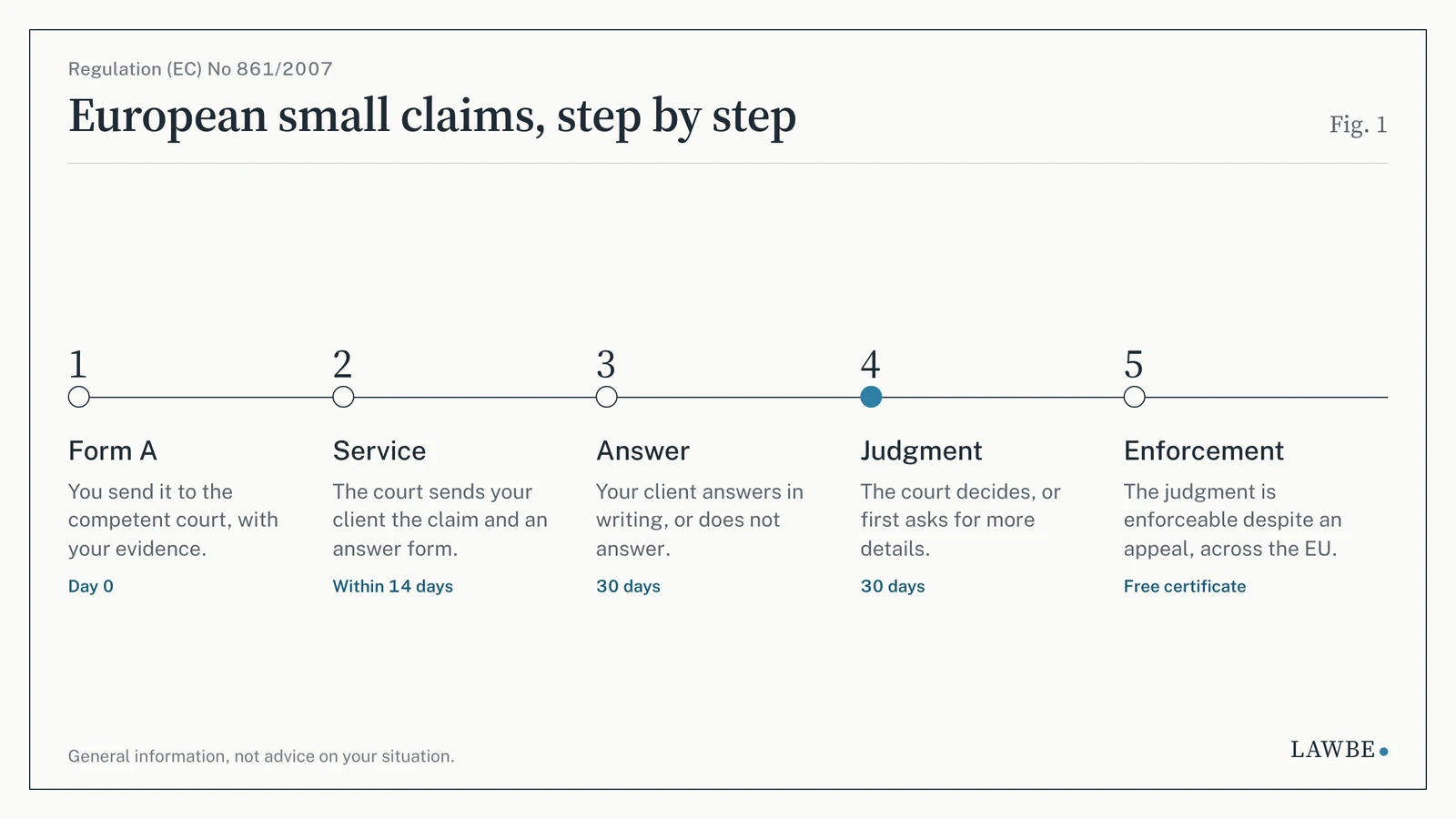
A hearing is held only if the court cannot decide on the documents, or if a party asks for one and the court considers it useful. The judgment is enforceable even if your client appeals. It is enforced in the other Member States without any recognition procedure, with a certificate issued at no extra cost.
Which court do I file with?
The procedure does not say which country has jurisdiction: the ordinary European rules decide. As a rule, you sue before the courts of the country where your client is established.
A services contract may also be brought before the court of the place where the services were or should have been provided. A written clause choosing a court generally prevails.
If your client is a private individual who bought for private use, you can, as a rule, only sue in their country.
In Belgium, between two businesses, the enterprise court hears the claim, whatever the amount. Outside that case, the justice of the peace hears claims of 5,000 euros or less. Form A is written in the language of the court, for example in Dutch in Antwerp.
How much does it cost in Belgium?
On filing, you pay a contribution of 26 euros to the legal aid fund. The court registration fee is not paid in advance. The court charges it, in its final judgment, to the losing party; it becomes payable on that date. The law of 14 October 2018 set it at 165 euros before the enterprise court, then called the commercial court.
The losing party bears the costs of the proceedings, but the court does not award costs that were unnecessary or disproportionate. For a claim between 2,500.01 and 5,000 euros, the Belgian procedural indemnity has a base amount of 1,020.35 euros.
Above 2,500 euros, the enterprise court's judgment can be appealed; below that amount, it is final.
My client does not dispute the claim: is there another route?
When your client disputes nothing, two other routes are faster than the small claims procedure. The table compares the three.
| Route | For what amount | What stops it |
|---|---|---|
| European small claims | 5,000 euros at most | Nothing: the court decides, even if the client disputes |
| European order for payment | No ceiling | A statement of opposition, even without reasons |
| Recovery of undisputed debts (Belgium) | No ceiling, between businesses | A reasoned dispute |
The European order for payment covers money claims for a specific amount that are due, with no ceiling. Your client can still stop it with a mere statement of opposition, without having to give reasons. You can then ask for the case to continue under the small claims procedure, if that procedure is open.
In Belgium, an undisputed money debt between businesses can be recovered by a bailiff, at the request of the creditor's lawyer. Since 26 February 2026, this route has also been open to businesses entered in the commercial register of another Member State connected to the European interconnection system. It ends as soon as the debtor gives the reasons for disputing the debt. Its steps are set out in Unpaid invoice between businesses: 4 steps in Belgium.
Do I need a lawyer?
No. Representation by a lawyer is not mandatory, and each Member State must offer free practical help to fill in the forms, without a legal assessment of your case.
In my view, a lawyer is worth it mainly on three points. They choose the competent court and describe the evidence that carries the decision. They also choose the route when your client hesitates between paying and disputing. A claim outside the scope of the procedure is not rejected for that reason alone: unless you withdraw it, the court deals with it under its own national procedure, with other time limits.
What I actually do
I first check that the procedure is open to you and before which court. I then draft the formal notice, then Form A and the description of your evidence, in the language of the court. If your client does not dispute the claim, I tell you whether a faster route exists.
On the Business law page, the 45-minute scoping call costs 120 euros, prepaid, and chasing an unpaid invoice is listed from 290 euros. A dispute is subject to a quote and a cap per phase.
The exact price is given in writing after the first contact, which is free. Amounts excl. VAT.
Frequently asked questions
Does the 5,000-euro ceiling include interest?
No. The ceiling is calculated on the principal alone, when the court receives the form.
What happens if my client does not answer?
The court gives judgment on your claim, without waiting. Your file must therefore stand on its own: the contract or purchase order, the invoice, your written exchanges.
My client answers with a counterclaim above 5,000 euros: what happens to the procedure?
Both claims leave the small claims procedure and follow the procedural law of the court's country.
Is the judgment enforceable in my client's country?
Yes, without any recognition procedure. You ask the court for the certificate, issued at no extra cost, and enforcement then follows the rules of the country where it takes place.
A client in another EU country is not paying. Take the test: two minutes, then you write to me with the result.
Sources
- Regulation (EC) No 861/2007 of 11 July 2007 establishing a European Small Claims Procedure, Articles 2 to 7, 10, 11, 15, 16 and 20 (consolidated version of 1 May 2025, CELEX 02007R0861-20250501); original text, Article 2(3) (CELEX 32007R0861).
- Regulation (EC) No 1896/2006 creating a European order for payment procedure, Articles 4 and 16 (CELEX 32006R1896); Article 17, as replaced by Regulation (EU) 2015/2421, Article 2(2) (CELEX 32015R2421).
- Regulation (EU) No 1215/2012 on jurisdiction and the recognition and enforcement of judgments in civil and commercial matters, Articles 4, 7, 18 and 25 (CELEX 32012R1215).
- Belgian Judicial Code, art. 573, 590 and 617 (NUMAC 1967101054); art. 1394/20 and 1394/23 (NUMAC 1967101056).
- Law of 14 October 2018 amending the Code of registration, mortgage and court fees to reform court fees, art. 2 and 3 (NUMAC 2018015308).
- Antwerp enterprise court, guide to the European small claims procedure, May 2026.
- Belgian courts and tribunals, "Amount of the procedural indemnity", amounts in force since 1 March 2025.
- European e-Justice Portal, "Small claims" page.
This article is general information, current as of 2 November 2026. It is not an opinion on your situation.
Translated from the French original published on 2 November 2026. The analysis concerns Belgian and European Union law. Read the French original.